Winter service · New Hampshire
Winter service in Manchester
What winter is really like in Manchester, New Hampshire: about 130 nights a year below freezing, 56.8 inches of snow in 2025, and no 30-year snowfall normal at all for the airport station — the nearest ones bracket the city at 61.4 inches (Concord) and 52.9 (Nashua). State law lets the city compel owners to clear the sidewalk; Chapter 97 never does, and the city 'encourages' instead. The rule that does bite is the odd/even overnight ban from 1 December to 15 April — 194 cars towed in one snow-emergency night, $200 cash to get one back.
Encouraged, not required
Search for the sidewalk rule in Manchester, New Hampshire and the first answer you find is somebody else’s. The “24 hours for snow, 12 for ice” deadline that search engines surface for “Manchester” belongs to Manchester, Connecticut, two states south. The New Hampshire city — the mill city on the Merrimack, the largest in northern New England — has no such clock, because it has no such duty.
That is worth stating precisely, because the state gives the city the power to impose one. RSA 47:17, the catalogue of what a New Hampshire city council may regulate by ordinance, includes under paragraph VII the authority to “compel persons to keep the snow, ice, and dirt from the sidewalks in front of the premises owned or occupied by them”. The section was amended as recently as August 2025. It is a power sitting on the shelf.
Turn to the city’s own code and it stays there. Chapter 97 of the Manchester Code of Ordinances, “Streets and Sidewalks”, opens with seven general provisions and exactly one of them mentions snow: § 97.03, which prohibits putting snow onto the sidewalk. Nothing in the chapter requires anyone to take it off.
The city says as much in plain language. On its Tips for Residents page the Highway Division writes: “Although the Highway Division snowblows many sidewalks, residents and business owners are encouraged to help clear them when possible.” Encouraged, not required — and the same division states that in winter it keeps over 650 miles (1,050 km) “of streets and sidewalks open and safe for travel”.
Burlington, Vermont has reached a similar place by a different road — there the unused power sits in the city charter. In Manchester the power is the state’s, the commitment is “many sidewalks” rather than a mileage, and the one rule that binds you concerns where you put the snow, not whether you move it.
A winter with no official average
Manchester is unusual among the cities on this site in one respect: there is no official 30-year snowfall normal for its airport station. The 1991–2020 normals that NCEI publishes for Manchester Airport carry temperature and precipitation values but no annual snowfall figure and no count of snow days. The National Weather Service explains why in its own climate report for the station: “HISTORICAL RECORDS AT MANCHESTER BEGAN IN 1885, BUT WITHIN THIS RECORD THERE REMAIN NUMEROUS YEARS OF UNAVAILABLE DATA.”
This is why secondary sites quote anything from 52 to 68 inches for the city — they are quoting neighbours. The honest way to state it is as a bracket. On the same NCEI normals, Concord, to the north, records 61.4 in (156 cm) a season (67.7 in a widely used compilation of the same data); Nashua, to the south, 52.9 in (134 cm). Manchester sits between the two on the map, and on the evidence, in the snow as well.
The observed record fills in the rest. NWS Gray — the office in Maine that forecasts for Portland as well as southern New Hampshire — reported 56.8 in (144 cm) at the airport in calendar 2025, with the deepest snow on the ground, 14 in (36 cm), on 17 February.
Temperature is where the normals do exist, and they describe persistence rather than extremes: 130.1 nights a year at or below 32 °F, 34.8 days on which the maximum never rises above freezing, and a January mean of 24.4 °F (−4.2 °C). The station is the airport, at 266 ft (81 m) some 3 miles (5 km) south of downtown; the river valley in the centre can differ.
Fifty feet of falls and four bridges
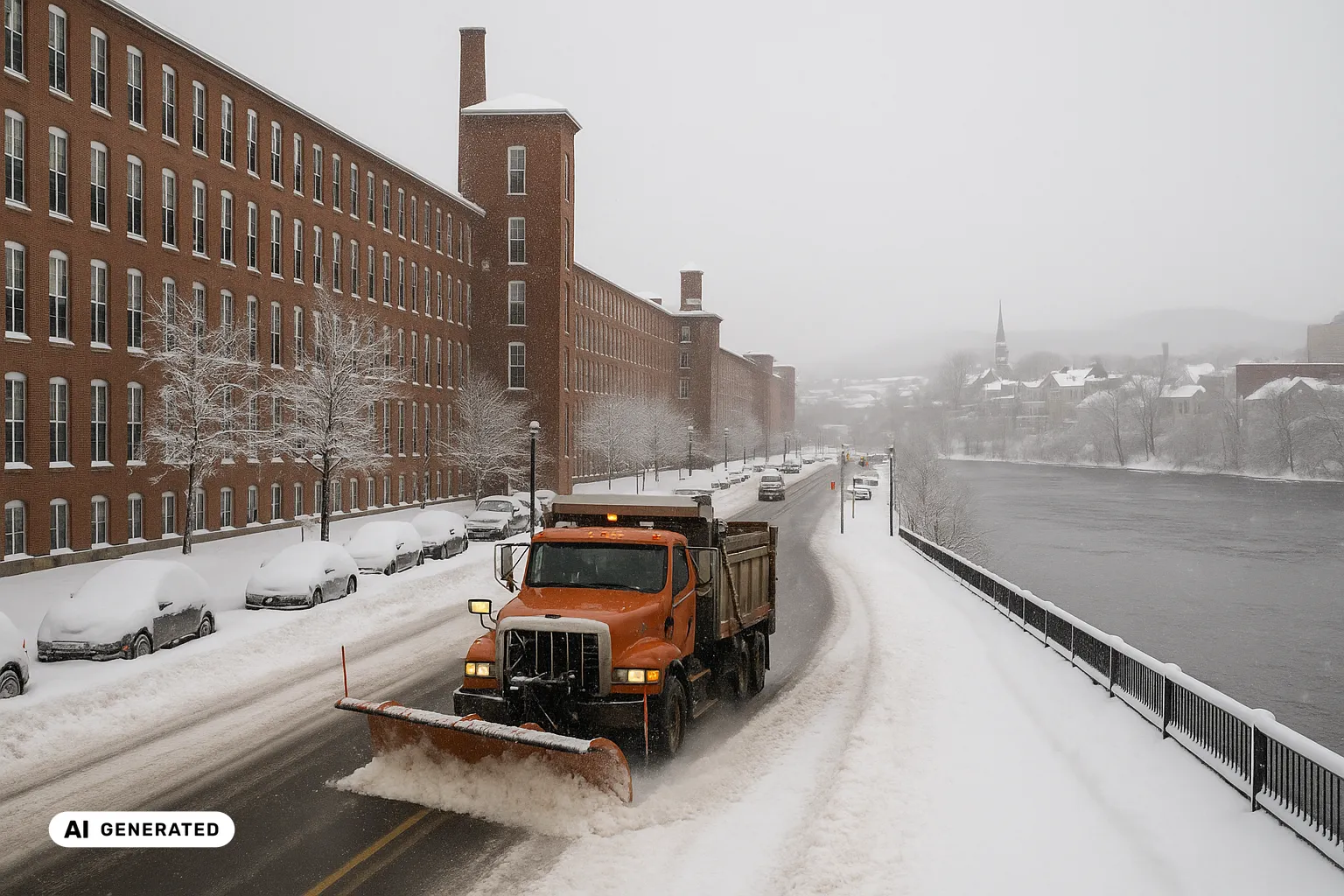
The city exists because of a drop. At Amoskeag Falls the Merrimack falls 50 ft (15 m) in a quarter of a mile, enough to power what was at its peak the largest cotton mill in the world — some 30 buildings and 17,000 employees. The Millyard is now offices, apartments and software companies, but the geometry it left is what a plow driver works: a tight grid around Elm Street between Bridge and Granite streets, a bank of brick along the water, and a city divided by its river.
East–west traffic crosses on four bridges inside the city — Queen City (1923), Granite Street (1981), Notre Dame (1988, twinned in 1990) and Amoskeag Memorial (1970). The city’s published material does not single them out; it is simply a general fact of winter that bridge decks freeze first, and a city whose halves connect at four points has four places where that matters.
Ground rises on both sides. The West Side climbs from the flats along the Piscataquog, which joins the Merrimack just upstream of the Queen City Bridge, up past Notre Dame, “below Rimmon Heights”. On the east the land rises towards Wellington Hill at 570 ft (174 m), the highest point in a city whose centre sits near 210 ft, and on to Lake Massabesic, the city’s drinking water.
One more line matters for anyone asking who plows what. I-293, the 11-mile (18 km) loop around the city, belongs to the New Hampshire DOT, as do I-93 and NH 101; city streets belong to the Highway Division. At the Granite Street ramps, which winter service you are looking at changes within a few metres.
What § 97.03 says, and whom it names
Section 97.03, “Throwing or putting snow in the city way prohibited”, is the whole of the snow law for property owners in Chapter 97, and it is one sentence:
“No person shall throw, place, of [sic] put, dispose of or cause to be thrown, placed, put, or disposed of, any snow, slush or ice onto any city-owned sidewalk or upon any city way.”
The slip is in the code as published; the section was last amended on 21 June 2022. The city’s practical restatement adds the words that matter to this page’s second audience: “It is unlawful for you or your contractors to push any snow or ice into a street, sidewalk or other right-of-way.” A contractor working a driveway in Manchester is inside the sentence.
What the penalty is, this page cannot tell you: § 97.99 refers violations to the citation schedule in § 38.06, which was not available for reading when this page was researched, so no dollar figure is quoted here.
The Highway Division’s practical advice is more useful than the rest of the chapter. When facing the street, clear your driveway to the right — on a one-way street, in the direction of traffic — so the plow’s pass carries the windrow away from the opening rather than back into it. Keep the front of your mailbox accessible; keep hydrants clear.
Odd and even, 1 December to 15 April
Where the neighbouring towns ban all overnight street parking for the season, Manchester bans one side. Under § 71.13 of the code, parking on public streets is prohibited between 1:00 and 6:00 a.m. from 1 December to 15 April, subject to an alternation: subsection (B) permits parking “on even house numbered sides of such streets on even-numbered days of each calendar month, and on odd-numbered sides of such streets on odd-numbered days of each calendar month”.
The city does not explain it that way. The Highway Division’s Winter Parking page asks for “vehicles to be parked only on the odd-numbered side of a street on odd-numbered calendar months, and only on the even-numbered side of a street on even-numbered calendar months”. Even side in December, odd side in January, and so on. That is how the city has communicated it for years. The codified text — current through an amendment of 3 October 2023 — says days. This page does not resolve the difference; it reports it. Follow the city’s current notice, and check before you park.
One carve-out comes from the code itself, and it is a piece of downtown you can walk across in a few minutes:
“The area bounded on the south side by and including Pleasant Street; on the north by and including Mechanic Street; on the west by and including Canal Street; and on the east by and including Franklin Street is hereby exempted from the provisions of odd and even parking.”
Fines are the second divergence. The penalty table for Chapter 71, last amended in 2009, lists odd/even violations at $25, $50 and $60 and snow-emergency violations at $75, $150 and $180. In November 2022 the Union Leader reported that the aldermen had doubled the base figures the previous month, to $50 and $150. Both figures are attributed here; the city’s page is the place to confirm.
Strobe lights, 194 tows, $200 in cash
The seasonal ban keeps one side open. A snow emergency clears both, and the city is candid about why: “A Snow Emergency is called to allow City crews to plow the full width of the streets.” Under § 71.05(A) the Public Works Director declares one “on the basis of falling snow, sleet, or freezing rain, or on the basis of a forecast … of snow, sleet, or freezing rain”. Freezing rain is an express trigger in the text.
Subsection (B) adds a second tier most residents never hear named: a “snow maintenance emergency”, declared immediately after the first ends, for “expeditious snow removal operations” — the hauling-away that follows the plowing in a downtown with nowhere to push it.
Notice comes by text alert, by the sign-up page at manchesternh.gov/snow, and — the city’s own phrase — by “White, flashing strobe lights at major intersections”. Emergencies typically run 10 p.m. to 6 a.m.; the one declared for 20–21 February 2026 ran exactly that, with towing in the downtown district only after 1 a.m.
Towing is where Manchester’s rule has teeth. Section 71.14 makes any vehicle in violation “subject to removal and impoundment” and conditions its return on “the payment by the party seeking the release of said vehicle of all fees and charges incurred by the city and/or the towing company in the towing and storage of said vehicle”. In practice, per the city’s page, that means proof of ownership at the impound lot beside the Bridge Street entrance to Derryfield Park and $200 in cash within 24 hours.
The scale is documented. In the snow emergency of the night of 26 January 2026, 194 vehicles were towed, according to the local outlet Ink Link. The alternative is free: the city lists nine lots and garages open during a declared emergency, from Arms Park by the river to the Victory Parking Garage downtown, each with posted start and end times.
Over 650 miles, no published route count
The Highway Division of the Department of Public Works is the operator. Its published commitment is the 650 miles; its published philosophy is restraint — “the least amount of de-icing material necessary to restore safe travel conditions in a timely manner”. What it does not publish, on any current page, is the operational detail neighbouring cities do: route counts, fleet size, salt tonnage, time targets. The one city document with that information, a snow and ice operating procedure, dates from 2008–09 and exists online only as a scanned image. This page therefore states no fleet or route figure for Manchester.
Concord publishes its centreline miles and its 100 miles of sidewalk, cleared with school walking routes first; Nashua publishes 41 plow routes and a 72-hour target for its primary sidewalks. Manchester’s numbers may be comparable; they are simply not on the record.
One page the city does maintain is about what its plows break. Public Works repairs plow damage to standard mailboxes and posts only; custom ones “will not be replicated”. The page adds a line that says something about how the crews work: “In most cases, property damage will have already been reported by City crews.” The drivers, in other words, log what they hit.
A statute about policies carried out
New Hampshire has written down, in two places, what it expects of a public body’s winter service, and the language is worth knowing even though it applies to governments rather than to you. RSA 231:92-a provides that a municipality “shall not be held liable for damages arising from insufficiencies or hazards on public highways, bridges, or sidewalks … when such hazards are caused solely by snow, ice, or other inclement weather” — on one condition: that its “failure or delay in removing or mitigating such hazards is the result of its implementation, absent gross negligence or reckless disregard of the hazard, of a winter or inclement weather maintenance policy or set of priorities adopted in good faith”.
RSA 507-B:2-b extends the same test to any premises a governmental unit owns or operates — car parks and walkways included — and adds that winter maintenance programmes certified under RSA 489-C:2-a are presumed to meet the standard.
What the two sections share is that word, implementation. The protection is tied not to having a policy but to carrying it out, and that is only visible afterwards in records: which street, which walk, when, with what. That is the documentation question for a municipal winter service and for any contractor doing part of the work under one. It is a statement about public bodies, not about private owners.
Across the town line, the rule flips
Manchester’s odd/even alternation stops at the city limits, and every neighbour with a published rule bans the whole street instead.
Bedford, to the south-west, prohibits parking “on any public highway between the hours of 12 midnight and 8 a.m.” from 1 November to 1 April, with a penalty “not to exceed $50 for each offense”. Goffstown, to the west, runs its ban from 15 November to 15 April, 2 to 5 a.m., without signs — “a town ordinance that has been on the books for a number of years” — plus a separate snow emergency ordinance from 2015 (PDF). Concord bans from midnight to 7 a.m. in two flavours, a citywide “Winter Storm Event” ban and a downtown “Winter Maintenance” ban. Nashua encourages sidewalk clearing much as Manchester does, and puts a fine of up to $1,000 on pushing snow back into the street.
For a New England city that puts the public sidewalk on the abutting owner — the arrangement Manchester declines — Worcester and Boston, an hour south in Massachusetts, are the nearest cases on this site. A few miles across a town line here, “where do I park tonight” has four different answers.
Keeping a record where the city holds the snowblower
Manchester moves the documentation question rather than removing it. The public sidewalk is mostly the Highway Division’s. What remains is private ground — entrances, steps, car parks, the walk between a building and the strip the city snowblows — and the contractor named in the city’s restatement of § 97.03 who works it. Nobody else is keeping a record of that work.
Wintertrace is self-hosted software for recording winter service work: which site was attended, when, by whom, what material went down and how much, with the weather conditions of the shift captured automatically and a service record with GPS track and photos that you can produce months later. It runs on your own web hosting, without a subscription, and the data stays with you.
Two local details make the record worth more here. Manchester has no official snowfall normal, so “how much fell that night” is not a figure you can look up afterwards — the weather captured at the time of the operation is what you have. And the state’s statutes describe protection for public winter service in terms of a policy implemented; a private contractor is not covered by them, but the same shape of evidence — what was done, when, in what conditions — is what a client asks for after an icy morning.
A note on all of the above
This page is general information about winter service in Manchester, New Hampshire, drawn from the city’s Highway Division pages, the Manchester Code of Ordinances and the New Hampshire Revised Statutes as read on 24 September 2026 (Chapter 71 current through 3 October 2023, § 97.03 through 21 June 2022). It is not a substitute for legal advice, and it is not a statement of what applies to any particular property — least of all the finding that Chapter 97 contains no sidewalk duty, which describes that chapter and the city’s own guidance, not every rule that might bear on a private path or step. The odd/even wording and the fine schedule differ between the code and the city’s communications, and the impound fee is marked “subject to change”, so check the city’s current pages before relying on anything here.
Local facts
- There is no official 1991–2020 snowfall normal for Manchester Airport (NCEI station USW00014710): the dataset carries temperature and precipitation normals but no annual snowfall value and no count of snow days. The National Weather Service notes that records 'began in 1885, but within this record there remain numerous years of unavailable data'.Source
- The nearest normals bracket the city. Concord, to the north, records 61.4 inches (156 cm) a season over 29.7 days with an inch or more on the NCEI figures — 67.7 inches in a widely used compilation of the same data. Nashua, to the south, records 52.9 inches (134 cm) over 18.9 days.Source
- Observed at the airport in calendar 2025: 56.8 inches (144 cm) of snow, a largest 24-hour fall of 8.8 inches on 8–9 February, a deepest snow cover of 14 inches (36 cm) on 17 February, 139 days with a low at or below 32 °F, five at or below 0 °F, and a coldest morning of −9 °F (−23 °C) on 22 January.Source
- The temperature normals do exist: 130.1 nights a year at or below 32 °F, 34.8 days on which the maximum stays at or below freezing, and 3.0 nights at or below 0 °F (−18 °C). January's mean is 24.4 °F (−4.2 °C) with a mean low of 15.7 °F.Source
- The city stands where the Merrimack drops 50 feet (15 m) over a quarter of a mile at Amoskeag Falls. Samuel Blodget completed a canal and lock system around the falls in 1807; the mills that followed made Amoskeag, at its peak, the largest cotton textile plant in the world, with around 30 buildings and 17,000 employees.Source
- East–west traffic crosses the river on four bridges inside the city: Queen City Bridge (1923), Granite Street Bridge (1981), Notre Dame Bridge (1988, twinned in 1990) and Amoskeag Memorial Bridge (1970). Hooksett's Main Street Bridge (1976) lies just beyond the northern line.Source
- Manchester covers 34.9 square miles, 1.9 of them water. The centre sits near 210 feet (64 m); the highest point is Wellington Hill at 570 feet (174 m). Lake Massabesic on the eastern border, about 2,560 acres (1,040 ha), is the city's drinking water supply and closed to swimming.Source
- I-293, the 11-mile (18 km) loop forming two sides of a triangle around the city, is maintained by the New Hampshire DOT, not the city; NHDOT's Bureau of Highway Maintenance covers about 8,710 lane-miles statewide in six districts. City streets belong to the Highway Division.Source
- Chapter 97 of the Manchester Code of Ordinances, 'Streets and Sidewalks', opens with seven general provisions (97.00–97.06). Only one, § 97.03, mentions snow — and it prohibits putting snow onto the sidewalk. None requires an abutting owner to clear it.Source
- Section 97.03 in full: 'No person shall throw, place, of [sic] put, dispose of or cause to be thrown, placed, put, or disposed of, any snow, slush or ice onto any city-owned sidewalk or upon any city way.' It dates from 1963 and was last amended on 21 June 2022; its penalty is set by the citation schedule in § 38.06.Source
- The city's own guidance: 'Although the Highway Division snowblows many sidewalks, residents and business owners are encouraged to help clear them when possible.' The same page says it is 'unlawful for you or your contractors to push any snow or ice into a street, sidewalk or other right-of-way', and advises clearing a driveway to the right when facing the street.Source
- State law would allow a duty. RSA 47:17 VII lists among a city council's ordinance powers the authority to 'compel persons to keep the snow, ice, and dirt from the sidewalks in front of the premises owned or occupied by them'. The section was last amended effective 1 August 2025.Source
- In winter the Highway Division 'keeps over 650 miles of streets and sidewalks open and safe for travel' — about 1,050 km — and states that it uses 'the least amount of de-icing material necessary to restore safe travel conditions in a timely manner'. It does not publish a split between streets and sidewalks, or route and fleet counts.Source
- Section 71.13 prohibits parking on public streets between 1:00 and 6:00 a.m. from 1 December to 15 April, allowing it 'on even house numbered sides of such streets on even-numbered days of each calendar month, and on odd-numbered sides of such streets on odd-numbered days'. The downtown block bounded by Pleasant, Mechanic, Canal and Franklin streets is exempted. Current through an amendment of 3 October 2023.Source
- The city's Winter Parking page describes the same rule by calendar month, not day: odd side in odd-numbered months, even side in even-numbered months, from 1 December at 1:00 a.m. to 15 April at 6:00 a.m. Where daytime parking is allowed on one side only, that side stays available every night; no overnight parking on the circular end of a cul-de-sac.Source
- The codified penalty table for Chapter 71, last amended in 2009, reads 'Odd/even $25/$50/$60; Parking prohibition $25/$50/$60; Snow emergency $75/$150/$180'.Source
- In November 2022 the Union Leader reported that the aldermen had raised the odd/even fine to '$50 (increased from $25)' and the snow-emergency fine to '$150 (increased from $75)' the previous month, on the police chief's recommendation. A 2019 city alert had put the overnight fine at $25.Source
- Under § 71.05(A) the Director declares a snow emergency 'on the basis of falling snow, sleet, or freezing rain, or on the basis of a forecast … of snow, sleet, or freezing rain'. Subsection (B) adds a second tier, a 'snow maintenance emergency' declared immediately afterwards for 'expeditious snow removal operations'. Either lasts 'until terminated by announcement of the Director'.Source
- The city's stated reason: 'A Snow Emergency is called to allow City crews to plow the full width of the streets.' Notice comes by the city's text alert service, the sign-up page at manchesternh.gov/snow, and 'White, flashing strobe lights at major intersections'. Emergencies typically run 10 p.m. to 6 a.m.Source
- Section 71.14 makes release of a towed vehicle conditional on 'the payment by the party seeking the release of said vehicle of all fees and charges incurred by the city and/or the towing company in the towing and storage of said vehicle', plus proof of the right to possession and a signed receipt.Source
- Towed vehicles go to the city impound lot beside the Bridge Street entrance to Derryfield Park. Release costs $200 in cash within 24 hours of the tow, 'fees subject to change', with storage charges after. The figure was $110 in 2019 and 2021.Source
- In the snow emergency of the night of 26 January 2026, 194 vehicles were towed, according to the local outlet Ink Link. Its author's 2015 university study had found that 62 % of those towed in Manchester had not known the rule.Source
- Nine free lots and garages open during a declared emergency, each with posted hours: Arms Park, the public lot north of the Tru Hotel, Gill Stadium (Beech Street side), the Hartnett Lot, Livingston Park (end of Beech Street only), Precourt Park, Barbara Shaw Park, behind the West Side Arena, and the Victory Parking Garage. On 20–21 February 2026 the emergency ran 10 p.m. to 6 a.m., downtown towing began after 1 a.m., and Victory Garage charged $1 an hour outside its posted window.Source
- Public Works repairs plow damage only to 'standard mailboxes and posts that are readily and locally available'; custom mailboxes 'will not be replicated', and structures not built to code or lacking a permit are not repaired. The page adds: 'In most cases, property damage will have already been reported by City crews.'Source
- RSA 231:92-a shields a municipality from liability for hazards on highways, bridges or sidewalks 'caused solely by snow, ice, or other inclement weather' where its failure or delay 'is the result of its implementation, absent gross negligence or reckless disregard of the hazard, of a winter or inclement weather maintenance policy or set of priorities adopted in good faith'.Source
- RSA 507-B:2-b applies the same test to any premises a governmental unit owns or operates, and adds that municipal winter maintenance programmes certified under RSA 489-C:2-a 'shall be presumed to meet the standards herein for all public roads, parking areas, and walkways in the absence of proof to the contrary'.Source
- Every neighbour with a published rule bans the whole street rather than one side. Bedford: midnight to 8 a.m., 1 November to 1 April, up to $50. Goffstown: 2 to 5 a.m., 15 November to 15 April, $15 rising to $30 after 36 hours, no signs posted. Concord: midnight to 7 a.m., $50 ticket or $200 tow.Source
- Concord and Nashua publish what Manchester does not: Concord clears '220 centerline miles (440 lane miles)' and 'approximately 100 miles of sidewalk' on a priority basis; Nashua runs 41 plow routes over 700-plus lane miles, aims to clear primary sidewalks within 72 hours of a storm's end, and fines pushing snow into the street up to $1,000.Source
Official contacts
Manchester Highway Division — Winter Operations
The Department of Public Works' winter entry page: the 650-mile commitment, the de-icing philosophy, and links to every winter sub-page.
Manchester Highway Division — Winter Parking and Snow Emergency Parking Rules
The city's own statement of the odd/even rule, the free snow-emergency lots, the impound lot and the release fee. Check this before parking.
Manchester Highway Division — Snow Emergencies
Why an emergency is called, what happens to vehicles, and how to sign up for alerts.
Manchester Highway Division — Tips for Residents
Sidewalks ('encouraged'), the § 97.03 rule on pushing snow into the street, and the driveway advice.
Manchester Code of Ordinances — Chapter 71, Snow Emergency Regulations
The declaration power (§ 71.05), the odd/even section (§ 71.13), impoundment (§ 71.14) and the penalty table.
Manchester Code of Ordinances — Chapter 97, Streets and Sidewalks
The general provisions, including § 97.03. Short enough to read in full and confirm what is not there.
New Hampshire DOT — Bureau of Highway Maintenance
For I-93, I-293 and NH 101, which the state maintains rather than the city.
National Weather Service Gray, Maine — Manchester annual climate report
The forecast office for southern New Hampshire; its yearly summary for the airport station, with the data-gap caveat in its own words.
Common questions about winter service in Manchester
- Do I have to shovel the sidewalk in front of my house in Manchester, New Hampshire?
- Not under Chapter 97 of the city code, which is the chapter headed 'Streets and Sidewalks', and not according to the city's own guidance. The chapter's general provisions run from § 97.00 to § 97.06 and the only one about snow, § 97.03, tells you where not to put it — onto a city sidewalk or a city way. The Highway Division's Tips for Residents page says that it 'snowblows many sidewalks' and that owners are 'encouraged to help clear them when possible'. That is a request, not a requirement. What this page cannot tell you is whether any other part of the code, for example the housing code, bears on private paths and steps, or what a lease or a condominium's rules say about them. Those are separate questions from the public sidewalk.
- I found a '24 hours for snow, 12 for ice' deadline for Manchester online. Is that real?
- It is real, but it belongs to Manchester, Connecticut — a different town in a different state, with a downtown special services district that circulates exactly that reminder each winter. Search engines merge the two Manchesters freely, and the Connecticut ordinance on 'Snow and Ice Removal from Sidewalks' turns up in results for the New Hampshire city. Manchester, New Hampshire has no sidewalk clearance deadline in Chapter 97 and no such rule on its Highway Division pages. If a page quoting a deadline for 'Manchester' carries an 860 area code or mentions Hartford, it is the other one.
- Could the city require owners to clear the walk if it chose to?
- Yes, and the power is explicit. RSA 47:17 sets out what a New Hampshire city council may regulate by ordinance, and paragraph VII includes the authority to 'compel persons to keep the snow, ice, and dirt from the sidewalks in front of the premises owned or occupied by them'. The statute was amended as recently as August 2025, so it is not a dead letter. Manchester has, on the evidence of Chapter 97 and its own guidance, chosen not to use it — the Highway Division clears sidewalks itself as part of its 650 miles. Burlington, Vermont has reached a similar arrangement through a charter power its council has never exercised; the difference in Manchester is that the power is the state's and the city's commitment is described as 'many sidewalks' rather than a counted mileage.
- Which side of the street do I park on tonight?
- The side the city's current notice tells you, and it is worth reading that notice rather than the code. Section 71.13(B) of the code says parking is allowed on the even-numbered side 'on even-numbered days of each calendar month' and on the odd side on odd-numbered days. The city's Winter Parking page — and its alerts and the local press, year after year — says odd side in odd-numbered months and even side in even-numbered months, so even in December, odd in January, and so on. The two do not say the same thing, and this page cannot tell you which a given officer works from. The practical answer is to follow the city's published rule, which is the version residents are actually ticketed against, and to remember the ban only runs from 1:00 to 6:00 a.m. Where daytime parking is already restricted to one side, that side stays open overnight; the downtown block between Pleasant, Mechanic, Canal and Franklin streets is exempt altogether.
- What does an overnight parking ticket cost?
- Two figures are in circulation and both are attributed here. The penalty table in Chapter 71, whose last amendment dates from 2009, lists odd/even violations at $25, $50 and $60 — three ascending figures that read as first, second and subsequent offences, though the table does not label them — and snow-emergency violations at $75, $150 and $180. In November 2022 the Union Leader reported that the aldermen had doubled the base figures the previous month, to $50 for odd/even and $150 for a snow emergency. A 2019 city alert had still said $25. Either the online schedule has not caught up with the 2022 vote or the new figures live in a different part of the code; the city's Winter Parking page, which says only that you 'may be fined … per City Ordinances, including Chapter 71', is the place to confirm. A tow is a separate cost on top of any ticket.
- How will I know a snow emergency has been declared?
- Three ways, and one of them is visible from the street. The city runs a text alert service by ZIP code and a sign-up page at manchesternh.gov/snow. During the emergency itself the city switches on what it describes as 'White, flashing strobe lights at major intersections', so a driver coming home late sees the signal without a phone. Emergencies typically run 10 p.m. to 6 a.m., though they can start earlier or run later in a heavy storm; the one declared for 20–21 February 2026 ran exactly 10 p.m. to 6 a.m. Under § 71.05 the Director can declare one on a forecast, not only on falling snow, and freezing rain is written into the text as a trigger in its own right. The declaration lasts 'until terminated by announcement of the Director', and the Director may follow it immediately with a 'snow maintenance emergency' to clear the way for hauling snow out of downtown.
- My car was towed during a snow emergency. Where is it, and what does it cost to get back?
- It is at the city's impound lot beside the Bridge Street entrance to Derryfield Park, on the East Side. The city's page says the owner must present proof of ownership and pay $200 in cash within 24 hours of the tow, with storage charges accruing after that; the fee is marked 'subject to change' and was $110 as recently as 2021. Section 71.14 of the code is the legal basis: release is conditional on paying 'all fees and charges incurred by the city and/or the towing company', showing a right to possession and signing a receipt. The scale of this is worth knowing before the first storm rather than after — 194 vehicles were towed in the single emergency night of 26 January 2026, according to Ink Link. The free alternative is any of the nine city lots and garages listed for snow emergencies, each with posted hours; the Victory Parking Garage charged $1 an hour outside its posted window in February 2026.
- I run a plowing business here. What does the ordinance say about me?
- It names you, indirectly but clearly. Section 97.03 prohibits any person from putting snow, slush or ice 'onto any city-owned sidewalk or upon any city way', and the city's practical restatement of it reads: 'It is unlawful for you or your contractors to push any snow or ice into a street, sidewalk or other right-of-way.' A contractor clearing a driveway or a car park in Manchester is inside that sentence, and so is the client who hired them. The penalty is set by the citation schedule in § 38.06, which was not available for reading when this page was researched, so no dollar figure is given here. The city's advice on where snow should go instead — to the right when facing the street, or in the direction of traffic on a one-way street, so the plow's next pass carries the windrow away from the opening — is a good default for a driveway contract. And during a declared snow emergency the city's own plows are working the full width of the street, which is not the moment to be pushing a windrow into it.
- The city plow hit my mailbox. Will the city fix it?
- If it was a standard one, generally yes. The Highway Division's plow-damage page says Public Works 'will only install standard mailboxes and posts that are readily and locally available; custom or special order mailboxes will not be replicated', and that any damaged structure 'not constructed to code and/or lacks any necessary permit will not be repaired or replaced' — a fence or wall inside the right of way without a permit is on you. To report damage you give your name, address, the object that was struck, and the date and approximate time. The page adds a sentence that tells you something about how the crews work: 'In most cases, property damage will have already been reported by City crews.' The drivers log what they hit, and the report you file is checked against theirs.
- How much snow does Manchester get in a winter?
- Nobody can give you an official figure, and any page that does is quoting a neighbour. NCEI's 1991–2020 normals for the airport station carry temperature and precipitation but no annual snowfall normal and no count of snow days, because — in the Weather Service's own words — the record since 1885 contains 'numerous years of unavailable data'. That is why secondary sites quote anything between 52 and 68 inches for the city. The honest answer is a bracket: Concord, north, records 61.4 inches a season on the NCEI figures (67.7 in a common compilation of the same data), Nashua, south, 52.9, and Manchester recorded 56.8 inches in calendar 2025 with a deepest cover of 14 inches in February. What the normals do say is how long winter lasts: about 130 nights a year below freezing and 35 days on which it never thaws.
- Is freezing rain alone enough to trigger a snow emergency?
- On the text of the ordinance, yes. Section 71.05(A) lets the Director declare a snow emergency 'on the basis of falling snow, sleet, or freezing rain, or on the basis of a forecast … of snow, sleet, or freezing rain', whenever conditions make it necessary that traffic be expedited and parking be prohibited 'for snow plowing and other purposes'. Freezing rain is listed on its own, not as a companion to snow. That matters in a river-valley city with a January mean of 24.4 °F and roughly 35 days a year that stay below freezing all day, where an ice event can arrive with no snow to plow at all. Whether a particular ice storm brings a declaration is the Director's call; the code gives the power and does not set a threshold in inches or in anything else.
Documenting winter service in Manchester
Anyone clearing snow and ice in Manchester may later need to show when and where a route was treated. Wintertrace is open-source software that records exactly that — time, location and weather for each run — as a calm basis for your own operational records and service proof. It is not a substitute for legal advice.
This overview is for general information and is not legal advice. Local rules on snow and ice clearing vary — the wording of the local rule and the responsible authority always govern.