Winter service · Illinois
Winter service in Rockford
What winter is really like in Rockford, Illinois: 37.1 inches of snow a season against Chicago's 38.4 on the same normals — but 135.8 frost nights to Chicago's 121.3 and 11.5 nights at or below zero to 6.5. The § 26-10 noon deadline that binds only lots "to which the general public is invited", the Illinois Snow and Ice Removal Act and the 2016 decision that marked its limit, the odd/even rule and the $60 ticket, and why the plow contractor never carries salt.
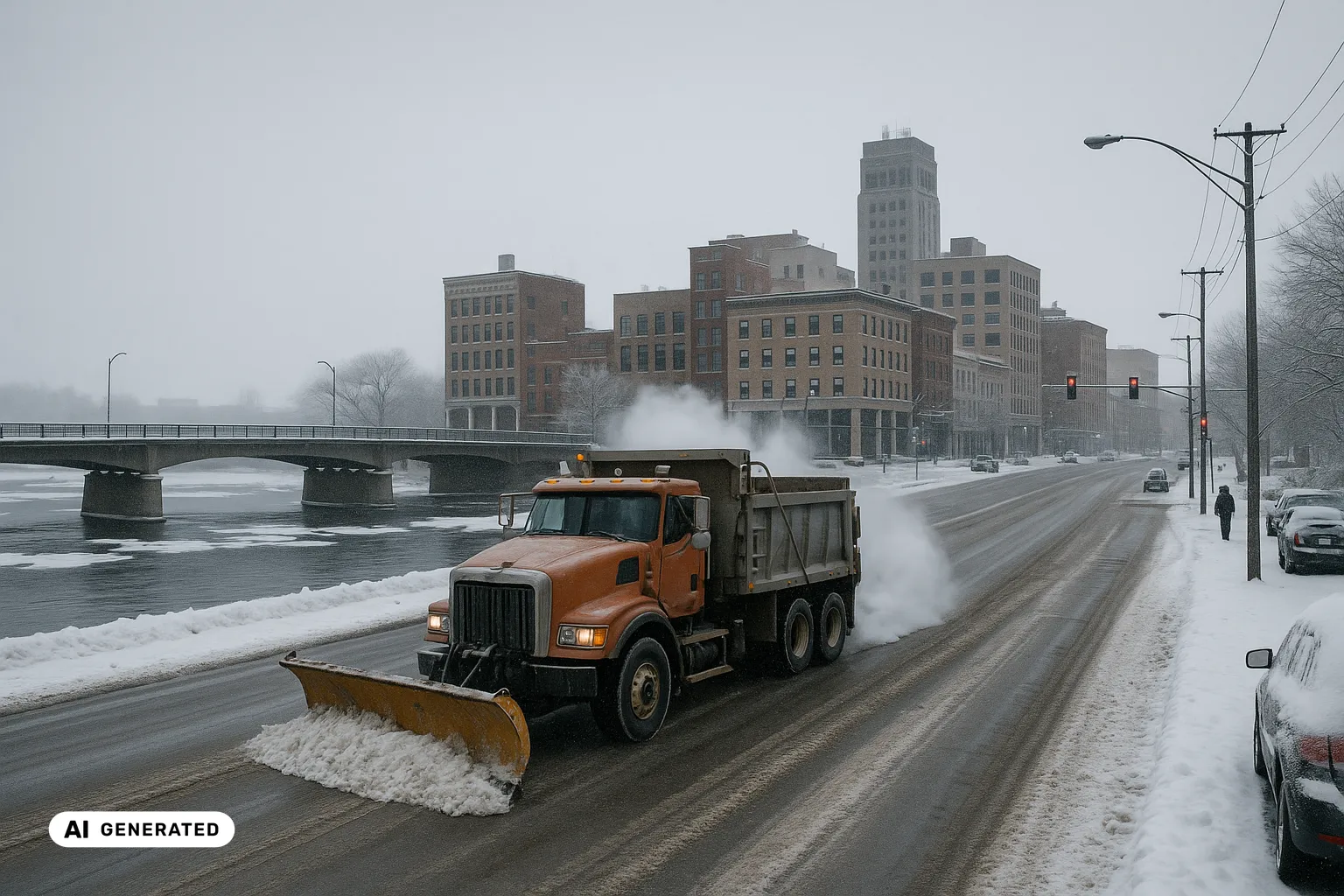
Rockford sits ninety miles west-north-west of Chicago on the Rock River, and the usual way of describing its winter is that it gets more snow than the big city downstate. It does not.
On the 1991–2020 normals, the National Weather Service puts Rockford at 37.1 inches a season and Chicago O’Hare at 38.4. Both figures come from the same table, the same period, the same office. Rockford is a little over an inch behind.
What Rockford has instead is a harder freeze. Mean January low: 14.5 °F, against Chicago’s 18.8. Nights at or below freezing: 135.8 a year, against 121.3. Days that never climb above freezing: 50.0, against 43.4. Nights at or below 0 °F: 11.5, against 6.5 — very nearly double.
In the polar vortex at the end of January 2019, Rockford recorded −31 °F, an all-time record for the city. O’Hare, in the same event, reached −23 °F. Eight degrees, ninety miles.
The lake warms Chicago. It does not reach here.
The state climatologist’s office puts the mechanism plainly: “The large thermal mass of the lake tends to moderate temperatures, causing cooler summers and warmer winters” — an effect it attributes to north-eastern Illinois and to Chicago in particular.
The same source notes something that makes the comparison cleaner than people expect: because prevailing winds here are westerly and north-westerly, Chicago generally sits on the windward side of Lake Michigan. The lake-effect belt is on the far shore, in Michigan. So Chicago’s lake never gave it extra snow for Rockford to be short of. It gives it warmer nights.
That is why the two columns diverge the way they do — snow almost identical, cold far apart. And it is a description rather than a citation: no agency has published the sentence “Rockford is colder because the lake is missing”. What is published is the moderation effect and the numbers, and they point the same way.
There is one seasonal detail worth having. Winter starts earlier here. Rockford’s December snowfall normal is 9.4 inches to Chicago’s 7.6, and it sees 18.0 November frost nights to Chicago’s 14.5. February reverses it — 8.5 inches here to Chicago’s 10.7. The season is shifted, not enlarged.
Measurable snow normally begins on 20 November and ends on 1 April. The snowiest season on record was 1978–79 at 74.5 inches; the least snowy, 1905–06, managed 2.8.
Where salt stops working, and what the city does about it
Here is where the cold stops being a statistic.
Ordinary road salt loses most of its usefulness at around 14 °F. Rockford has 11.5 nights a year at or below zero, and a mean January low nearly five degrees under that threshold. For a meaningful part of the winter, salt on its own is not the tool.
So every city salt truck carries about 12 tons of salt and, alongside it, tanks of sugar beet juice. The liquid goes onto the salt as it comes off the spinner, lowering the temperature at which the mix keeps working. The city gets through 12,000 to 18,000 tons of salt in a winter; the yard on South Central Avenue holds around 14,000 when full.
Note what this is and is not. It is a treatment applied at the moment of spreading, not a brine laid down before the storm. No pre-treatment programme is published for Rockford, and this page does not claim one.
The operating model on residential streets is unusual enough to be worth stating directly, because it splits one job between two parties:
Contractors do not salt City streets. The Public Works fleet will apply road salt on residential streets when the plowing operation is complete.
Contracted vehicles plow the residential network; the city’s own fleet comes along afterwards to salt it. A full residential pass takes 12 to 14 hours across 24 routes and 96 sections, using more than 150 plow vehicles and 15 to 20 skid steers, over 1,700 lane miles — plus 625 cul-de-sacs, each of which has to be worked as its own small problem, 42 miles of multi-use path and 48 public car parks.
And one sentence on the city’s own page joins the parking rules to the salt programme: streets with vehicles parked on both sides may get no salt at all. The car that stayed put is not just in the plow’s way; it can cost the whole street its treatment.
The windrow across the end of the driveway is not going away either. The city answers that complaint with a number: there are north of 60,000 curb cuts in Rockford, and clearing them individually would be cost prohibitive.
It is worth knowing that the same argument has been settled the other way elsewhere. In Bismarck, a citizen-initiated ordinance requires the city to use snow gates so that snow is not plowed into driveway openings, and directs that the extra cost be paid out of the city sales tax — with the requirement suspended once a snow emergency is declared. Same complaint, opposite resolution, and both cities can defend theirs.
What the local rules say, and where they go quiet
The City’s winter page puts sidewalk clearing under the heading “Citizen Responsibilities”, and lists “clearing sidewalks on property that border a public place, driveways, and alleys”. So the duty is the resident’s. That much is unambiguous and comes straight from the City.
What that page does not contain is a deadline. Not an hour, not a day.
The deadline is in § 26-10 of the Code of Ordinances, and the actual wording turns out to be narrower than the way it is usually reported:
The owner or occupier of each lot or part of lot, improved or unimproved, to which the general public is invited, shall remove all snow and ice which may have fallen or accumulated upon the sidewalk in front of the premises which he or she owns or occupies not later than 12:00 noon of the day after the same has ceased to fall or accumulate.
The phrase in the middle is the part almost every summary drops. As written, the duty attaches to lots to which the general public is invited — not to every residential frontage in the city. That is a materially different rule from Chicago’s, which binds every owner and occupant regardless of whether anyone is invited in, and it is worth reading the section for your own property rather than assuming the general version applies.
Two further parts of § 26-10 matter operationally.
Where ice has formed so that it cannot be removed, the owner or occupier must keep it “effectively sprinkled with sand, salt or other suitable substance in such manner as to prevent the ice from being dangerous, until such time as it can be removed, and then it shall be promptly removed”. So this is a treating duty as well as a clearing one — and in a city with 11.5 nights a year at or below zero, the treating half is the one that gets used.
And subsection (b) provides that a violator “shall be subject to a fine”, with “each day any violation of this section continues” constituting a separate offense. The section names no amount, so none is stated here; Chicago’s $50–$500 range is a different city’s rule.
The neighbouring § 26-9, “Throwing snow or water on sidewalks”, is shorter and in fact broader than the City’s paraphrase of it:
No person shall cast, throw or place any snow, or any water in freezing weather, on or along any sidewalk or street.
The City describes that section on its winter page as making it unlawful to plow, push, blow or otherwise deposit snow on public streets or places, expressly including snow taken off sidewalks and driveways. The code text is wider still — it covers water in freezing weather too. Either way: snow cleared from private ground stays on private ground.
An Illinois shield, and the case that marked its edge
Illinois has a statute that most states do not, and it applies in Rockford as it does everywhere else in the state. It is the most portable piece of knowledge on this page.
The Snow and Ice Removal Act declares it the public policy of the state that owners and others in residential units “be encouraged to clean the sidewalks abutting their residences of snow and ice”. It then backs that up: an owner, lessor, occupant or other person in charge of residential property who removes or attempts to remove snow or ice “shall not be liable for personal injuries … unless the alleged misconduct was willful or wanton”.
In other words, the state removes the perverse incentive to leave the walk alone.
But the shield has a documented edge, and it was drawn in Murphy-Hylton v. Lieberman Management Services, 2016 IL 120394, decided by the Illinois Supreme Court on 1 December 2016. The plaintiff fell on ice outside her condominium and argued that the ice came not from careless clearing but from defective conditions and inadequate maintenance of the property. The court held that the Act immunises against claims of negligent snow and ice removal — and not against claims that a defect or a failure to maintain produced an unnatural accumulation.
Two limits follow, and both belong on the page rather than in the small print. The statute says residential property, so commercial owners are not within it. And commentary on the decision from the Illinois State Bar Association and from practising firms observes that anyone who voluntarily takes clearing on — a landlord, an association, a contracted business — takes on the obligation to do it with care, with claims outside the removal-negligence box falling under ordinary law.
No decision was found applying the Act specifically to snow removal contractors one way or the other, so this page does not say that Illinois courts have ruled on that question. What it says is narrower: the statute names residential property, and the reported commentary is worth reading. Any of it applied to a real contract is a question for a lawyer. This is not legal advice.
Odd, even, and the word the city retired
Rockford’s parking regime is a calendar system rather than a route system, and it is the regional exception.
When the City declares, vehicles park on the odd-numbered address side on dates ending in an odd number and on the even side on dates ending in an even number. Everyone moves at 8 a.m., so on a second day the legal side flips in the morning. Police and dedicated snow ticketing staff issue $60 tickets on the wrong side. Normally-restricted spaces open up during a declaration, though disabled bays still need the permit.
Two things trip people up. The first, in the City’s own words:
Do not assume that you can move your car when the street is plowed. Your car must remain parked appropriately until after the Snow Emergency has been lifted.
The restriction is tied to the declaration, not to the plow going past — and on a following day the plows may or may not come back for the other side.
The second is the two-inch figure, which is regularly mis-stated. The City’s wording is: “When 2 inches of snow or more is expected to accumulate on the pavement, the City’s plowing contractor will be dispatched to clear residential streets.” Two inches sends the plow. The parking rule follows from the City declaring, which it typically does around that same threshold but which is not automatic. In Chicago, two inches on a snow route triggers the parking ban itself — a small difference that matters if you run routes in both places.
And in February 2026 the City Council changed what it calls all this. “Snow emergency” is now reserved for severe storms where travel is discouraged. For ordinary clearable snowfall, the City announces only that odd/even parking restrictions are in effect. The rules did not change — the sides, the 8 a.m. and the $60 are all as before. Downtown business owners had found that the word emergency kept customers away on days when the roads were merely snowy, and the mayor backed the change. Worth knowing, because the City’s own winter page still carried the older wording when this page was written; you will meet both names for the same thing.
Four authorities and a tollway
Winnebago County states the jurisdictional position better than any summary could:
The public highway system in Winnebago County is under the ownership of a variety of agencies including: one of 14 Townships, one of 12 Municipalities, the State of Illinois, the State Toll Highway Authority or us here at the County.
In practice that means City Public Works on city streets, with contractors plowing residential routes and the city fleet salting behind them; Winnebago County Highway Department on county roads; IDOT District 2, working from its yard on 11th Street, on the interstates, US routes and state highways — which puts the US 20 bypass in state hands; and the Illinois Tollway on I-90, the Jane Addams Memorial Tollway running back toward Chicago.
That last one is the distinction most often got wrong locally. The Tollway is its own agency. It is not IDOT, and a problem on I-90 does not belong to the state highway district.
The Rock River itself is the geography that shapes all of it. It splits the city into east and west sides — a division that goes back to the town’s founding on the west bank in 1834 — and everyday traffic crosses on a handful of downtown bridges: State, Jefferson, Whitman, Chestnut, Morgan. Free spans lose heat before the approach roads do, which is ordinary winter physics rather than a Rockford peculiarity; no local bridge pre-treatment programme is published, and this page does not invent one. The Jefferson Street crossing, an arch of 1925, carries a pedestrian bridge slung beneath the road deck — so part of the city’s winter walking network is literally under the traffic.
As for the “hills out of the river valley” that people mention: the honest version is a valley incised about 8 to 11 metres below the general level of the city, which sits at 728 feet. Short ramps at the valley edges and on the bridge approaches. Not a hill city.
Across the county line
Rockford’s rules stop at the city limits, and around here the neighbours mostly do something else.
Roscoe sets the sharpest sidewalk contrast: Village Ordinance 72.50 requires owners of residential and commercial property abutting a paved public sidewalk to clear snow and ice within 12 hours of the end of the event, and to keep it reasonably clear afterwards. Against Rockford’s noon-the-next-day, that can be many hours’ difference depending on when the snow stops.
On parking, the region is nearly unanimous against Rockford. Loves Park prohibits parking on all streets once two inches have fallen, at $25 a violation, with an extra overnight ban on North Second Street. Machesney Park clears every street, verge and ditch during a declaration, with fines from $25 to $100 plus towing. Belvidere bans parking city-wide under Ordinance 110-195 above two inches, and reckons it can do the whole place kerb to kerb in 8 to 10 hours — a smaller network, worked faster. Cherry Valley empties all village streets on declaration. Only Freeport and Pecatonica run odd/even the way Rockford does.
Rockton binds a notably wide group — “every owner, lessee, tenant, occupant or other person having charge” of a property abutting a public way — but sets no deadline at all.
A route that works Rockford and two neighbours is working three rulebooks, and the one with alternating sides is the middle one.
Keeping the record straight
In a city with 11.5 nights a year below zero, where the salt needs beet juice to keep working, where the plow and the salt arrive separately and hours apart, and where a parking restriction stays live after the street looks clear, the useful thing is being able to show plainly what was done and when.
Not to win an argument. Because a winter of 135.8 frost nights produces exactly the questions a vague answer cannot settle: was this walk cleared before noon the next day, was the lot treated or only plowed, what was the temperature when the material went down, and had the street been salted yet at all. A simple, time-stamped record of each treatment, set against what the weather was actually doing, turns “we were out on it” into something specific — a clear service record whether you look after one frontage off State Street or a route that runs north into Roscoe’s twelve-hour rule.
That is the documentation support Wintertrace is built to make easy. It does not change any local rule, and it is not a substitute for legal advice. It just means that when someone asks what happened during the last storm, the answer is on file.
Local facts
- Rockford and Chicago get almost exactly the same amount of snow. On the 1991–2020 normals the National Weather Service puts Rockford at 37.1 inches a season and Chicago O'Hare at 38.4 — and it publishes both in the same table, so the comparison is like for like.Source
- The cold is a different matter. Rockford's mean January low is 14.5 °F against Chicago's 18.8 °F. Rockford records 135.8 nights a year at or below freezing to Chicago's 121.3, 50.0 days that never rise above freezing to 43.4, and 11.5 nights at or below 0 °F to Chicago's 6.5 — nearly double.Source
- The single clearest illustration came in the polar vortex of late January 2019. Rockford fell to −31 °F on 31 January — an all-time record, breaking −27 °F from 1982. Chicago O'Hare, ninety miles east, bottomed out at −23 °F. Eight degrees, across one drive.Source
- Winter also starts earlier here. Rockford's December snowfall normal is 9.4 inches against Chicago's 7.6, and it has 18.0 November frost nights to Chicago's 14.5 — though February reverses it, with 8.5 inches here to Chicago's 10.7.Source
- The state climatologist's office attributes Chicago's milder nights to the lake directly: "The large thermal mass of the lake tends to moderate temperatures, causing cooler summers and warmer winters." It also notes that prevailing west and north-west winds leave Chicago on the windward side, so it is not a lake-effect snow target.Source
- The snowiest season on record in Rockford was 1978–79 with 74.5 inches, followed by 2007–08 with 72.9. The least snowy was 1905–06, with 2.8 inches.Source
- Measurable snow normally arrives on 20 November and ends on 1 April, with traces normal from 31 October to 11 April. About 28.1 days a year see at least a tenth of an inch.Source
- Every city salt truck carries about 12 tons of salt plus tanks of sugar beet juice, which is applied onto the salt as it leaves the spinner and lowers its working temperature. The reason is the climate above: salt on its own stops being much use at around 14 °F, and Rockford has 11.5 nights a year at or below zero.Source
- Plowing and salting on residential streets are done by two different parties, in sequence. The City states: "Contractors do not salt City streets. The Public Works fleet will apply road salt on residential streets when the plowing operation is complete."Source
- A residential pass takes 12 to 14 hours. The city is divided into 24 routes and 96 sections, worked by more than 150 plow vehicles and 15 to 20 skid steers, across 250 centreline miles of arterial and collector road and 529 centreline miles of local street — 1,700 lane miles in all, plus 625 cul-de-sacs, 42 miles of multi-use path and 48 public car parks.Source
- Streets with vehicles parked on both sides may get no salt at all — the City says so on its own winter page, which ties the parking rules and the de-icing programme directly together.Source
- Clearing the sidewalk is the resident's job. Under the heading "Citizen Responsibilities", the City lists "clearing sidewalks on property that border a public place, driveways, and alleys" — and gives no deadline of any kind on that page.Source
- The deadline is in Code of Ordinances § 26-10, and it is narrower than it is usually reported. It binds "the owner or occupier of each lot or part of lot, improved or unimproved, to which the general public is invited", who must clear the abutting sidewalk "not later than 12:00 noon of the day after the same has ceased to fall or accumulate".Source
- That qualifying phrase does the work. As written, § 26-10 reaches lots to which the general public is invited — not every residential frontage in the city. It is a considerably narrower duty than Chicago's, which binds every owner and occupant regardless of who is invited in.Source
- Where ice has formed so that it cannot be removed, § 26-10 requires the owner or occupier to keep it "effectively sprinkled with sand, salt or other suitable substance in such manner as to prevent the ice from being dangerous, until such time as it can be removed, and then it shall be promptly removed" — a treating duty, not merely a clearing one.Source
- Subsection (b) provides that a violator is subject to a fine and that "each day any violation of this section continues shall constitute a separate offense". The section states no amount; Chicago's $50–$500 range does not transfer.Source
- The neighbouring § 26-9, "Throwing snow or water on sidewalks", is shorter and broader than the City's paraphrase of it: "No person shall cast, throw or place any snow, or any water in freezing weather, on or along any sidewalk or street." The City describes it as a ban on plowing, pushing or blowing snow onto public streets, expressly including snow off sidewalks and driveways.Source
- Illinois law encourages residents to clear their walks and shields them when they do. Under the Snow and Ice Removal Act, an owner, lessor, occupant or other person in charge of residential property who removes or attempts to remove snow or ice "shall not be liable for personal injuries ... unless the alleged misconduct was willful or wanton".Source
- That shield has a documented limit. In Murphy-Hylton v. Lieberman Management Services, 2016 IL 120394, decided on 1 December 2016, the Illinois Supreme Court held that the Act immunises against claims of negligent snow removal — but not against claims that a defective condition or a failure to maintain the property produced an unnatural ice accumulation.Source (PDF)
- During a declared snow emergency, vehicles park on the odd-numbered address side when the date ends in an odd number and the even side when it ends in an even number. All vehicles must be moved to the correct side at 8 a.m., and both police and snow ticketing staff issue $60 tickets to those on the wrong side.Source
- The restriction does not end when the plow has been past. The City is explicit: "Do not assume that you can move your car when the street is plowed. Your car must remain parked appropriately until after the Snow Emergency has been lifted."Source
- Two inches is the trigger for the plow, not automatically for the parking rule: "When 2 inches of snow or more is expected to accumulate on the pavement, the City's plowing contractor will be dispatched to clear residential streets." The parking restriction follows from the City declaring one.Source
- In February 2026 the City Council changed the language. "Snow emergency" is now reserved for severe storms where travel is discouraged; for ordinary clearable snowfall the City announces only that odd/even parking restrictions are in effect. The parking rules themselves did not change — downtown business owners had found the word off-putting.Source
- The City does not clear the windrow at the end of a driveway, and explains why with a number: there are north of 60,000 curb cuts in Rockford, which makes clearing them individually cost prohibitive.Source
- Roads inside the city belong to several authorities. Winnebago County Highway Department states that the local highway system is owned by "one of 14 Townships, one of 12 Municipalities, the State of Illinois, the State Toll Highway Authority or us here at the County" — which is why the I-90 Jane Addams Memorial Tollway is run by the Tollway rather than by IDOT.Source
- Rockford is the regional exception on parking. Most neighbours ban parking outright rather than alternating sides: Loves Park prohibits parking on all streets once two inches have fallen, with a $25 fine, and Belvidere does the same under Ordinance 110-195, claiming it can clear the whole city kerb to kerb in 8 to 10 hours.Source
- Roscoe, just north, sets a sidewalk deadline Rockford does not match: Village Ordinance 72.50 requires owners of residential and commercial property abutting a paved public sidewalk to clear snow and ice within 12 hours of the end of the event, and to keep it reasonably clear afterwards.Source
Official contacts
City of Rockford — Snow & Ice (Public Works, Street Division)
The central winter page: citizen responsibilities, the odd/even rule and the $60 ticket, the two-inch dispatch threshold, Section 26-9 on depositing snow, the route and fleet figures, and the Snow Hotline on 779-348-7260.
The Council Clerk's route into the Rockford Code of Ordinances. Worth going to directly for the sidewalk clearing deadline, which the City's winter page does not state.
Winnebago County Highway Department — jurisdiction and map
Who owns which road in the county — townships, municipalities, the State, the Tollway or the County. The place to settle an argument about who should have plowed a given stretch.
NWS Chicago — 1991–2020 monthly and yearly normals for Chicago and Rockford
Both cities in one table, same period, same treatment. The source for every climate comparison on this page.
Illinois Courts — Murphy-Hylton v. Lieberman Management Services, 2016 IL 120394
The Illinois Supreme Court's decision on the reach of the Snow and Ice Removal Act, in full. Relevant statewide, not only in Rockford.
Common questions about winter service in Rockford
- Does Rockford get more snow than Chicago?
- No — and the belief that it does is worth correcting, because it points at the wrong risk. On the 1991–2020 normals, published by the National Weather Service with both cities in the same table, Rockford averages 37.1 inches a season and Chicago O'Hare 38.4. Rockford is 1.3 inches behind. What Rockford does get is cold: a mean January low of 14.5 °F against 18.8 °F, 135.8 nights at or below freezing against 121.3, and 11.5 nights at or below zero against 6.5. The lake that moderates Chicago's temperatures does not reach this far inland, and because prevailing winds put Chicago on the windward side, that lake never gave Chicago a snow advantage to lose. So the difference shows up on the thermometer, not the snow gauge — and de-icing chemistry is where you feel it.
- By when do I have to clear my sidewalk in Rockford?
- Noon the day after the snow stops — but read the section, because the duty is narrower than the summaries suggest. Code of Ordinances § 26-10 binds "the owner or occupier of each lot or part of lot, improved or unimproved, to which the general public is invited", requiring the abutting sidewalk to be cleared "not later than 12:00 noon of the day after the same has ceased to fall or accumulate". That qualifying phrase is routinely dropped in local reporting, and it means the section as written does not reach every residential frontage the way Chicago's ordinance does. Where ice has formed and cannot be removed, the section requires it to be kept effectively sprinkled with sand, salt or another suitable substance until it can be — a treating duty, not just a clearing one. Subsection (b) makes each day of continued violation a separate offence and provides for a fine without naming an amount. The City's own winter page, meanwhile, lists sidewalk clearing under "Citizen Responsibilities" and gives no deadline at all. This is general information, not a substitute for legal advice — check § 26-10 for your own property.
- Am I protected if I clear the walk and someone falls anyway?
- Illinois has a statute on exactly this point, and it is worth knowing in outline. The Snow and Ice Removal Act declares it state policy that residents be encouraged to clear the walks abutting their homes, and provides that an owner, lessor, occupant or other person in charge of residential property who removes or attempts to remove snow or ice is not liable for resulting personal injuries unless the misconduct was willful or wanton. Two limits are documented. The text says residential property, so commercial owners are outside it. And in Murphy-Hylton v. Lieberman Management Services, 2016 IL 120394, the Illinois Supreme Court held that the Act does not cover claims that a defective condition or a failure to maintain the property created an unnatural accumulation of ice — that is a different claim from negligent clearing. Bar association and law firm commentary on the decision goes further, noting that anyone who voluntarily takes on clearing takes on doing it carefully. How any of that applies to a particular arrangement is a question for a lawyer; this page is not one.
- How does the odd/even parking rule work, and what is the $60 for?
- When the City declares, vehicles park on the odd-numbered address side of the street on dates ending in an odd number, and on the even side on dates ending in an even number. Everyone moves to the correct side at 8 a.m., so if the declaration runs into a second day, the legal side flips in the morning. Police and dedicated snow ticketing staff issue $60 tickets for being on the wrong side. Two details catch people out. The restriction is tied to the declaration, not to the plow — the City states plainly that you should not assume you can move your car once the street has been plowed, and that on a following day the plows may or may not return for the other side. And spaces that are normally signed "No Parking" may be used during a declaration, though disabled bays still need the permit.
- Why did the city stop saying "snow emergency"?
- Because the word was doing damage downtown. In February 2026 the City Council changed the terminology: "snow emergency" is now reserved for severe winter storms where travel is discouraged, and for ordinary snowfall that simply needs clearing the City announces that odd/even parking restrictions are in effect. Business owners had found that declaring an emergency kept customers at home on days when the roads were merely snowy. The parking rules themselves are unchanged — same sides, same 8 a.m., same $60. Be aware that the City's own winter page still used the older wording when this page was written, so you may meet both phrasings for the same thing.
- Who plows which road around Rockford?
- At least four bodies, and the county spells it out: the public highway system in Winnebago County is owned variously by one of 14 townships, one of 12 municipalities, the State of Illinois, the State Toll Highway Authority, or the County. City Public Works handles streets inside Rockford, with contractors on the residential routes and the city fleet following behind to salt. Winnebago County Highway Department covers county roads. IDOT District 2 runs the interstates, US routes and state highways from its Rockford yard, which puts the US 20 bypass in state hands. And I-90, the Jane Addams Memorial Tollway between here and Chicago, belongs to the Illinois Tollway — a separate agency from IDOT, which is the distinction most people get wrong.
- Do the neighbouring towns work the same way?
- Mostly not, and Rockford is the odd one out. Alternating sides is unusual around here: Loves Park bans parking on all streets once two inches have fallen, with a $25 fine; Machesney Park bans it on every street, verge and ditch during a declaration; Belvidere does the same under Ordinance 110-195 and reckons on clearing the whole city kerb to kerb in 8 to 10 hours. Freeport and Pecatonica do run odd/even like Rockford. On sidewalks the sharpest contrast is Roscoe, where Village Ordinance 72.50 requires clearing within 12 hours of the end of the event — against Rockford's noon the following day, which depending on when the snow stops can be many hours later. Rockton binds a wide range of people, from owners to lessees to occupants, but names no deadline.
Documenting winter service in Rockford
Anyone clearing snow and ice in Rockford may later need to show when and where a route was treated. Wintertrace is open-source software that records exactly that — time, location and weather for each run — as a calm basis for your own operational records and service proof. It is not a substitute for legal advice.
This overview is for general information and is not legal advice. Local rules on snow and ice clearing vary — the wording of the local rule and the responsible authority always govern.