Winter service · South Dakota
Winter service in Sioux Falls
What winter is really like in Sioux Falls, South Dakota: around 45 inches of snow a season, but 26 nights a year at or below 0 °F and 65 days that never thaw, in seasons that have ranged from 5.4 to 94.7 inches. A zone system that clears north–south streets by day and east–west streets by night, a downtown that is hauled away rather than plowed, and a sidewalk ordinance whose 48 hours restarts when the city plow throws the snow back.
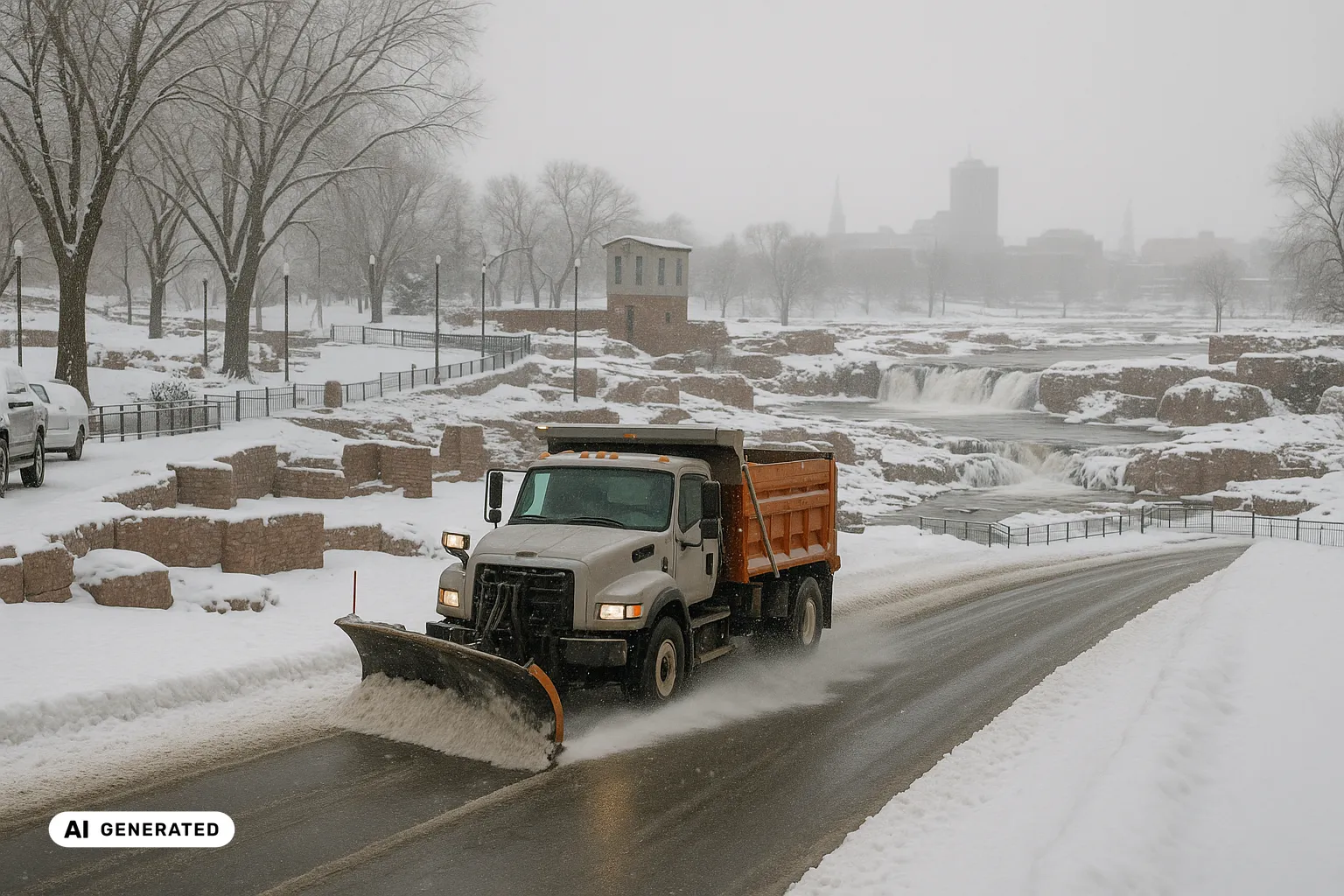
The worst blizzard of the century brought seven inches
On 10–11 January 1975 the National Weather Service office in Sioux Falls recorded what it still calls “the worst blizzard of the century in this area.” The snowfall was about 7 inches (18 cm). What made it the worst was everything else: gusts to 70 mph (113 km/h), wind chills to −70 °F, and visibility at the airport below a quarter of a mile for 24 hours without a break. Eight people died in South Dakota.
That storm is the shortest explanation of winter service in Sioux Falls. This is not a place that plans around volume; it plans around wind and cold. The same office’s page on the blizzard of 5–6 March 2018 reads the same way: 4 to around 10 inches of snow, winds to almost 60 mph, “whiteout conditions, and considerable blowing snow.”
The climate normals say it in numbers. On the 1991–2020 normals for Sioux Falls Foss Field, the temperature fails to rise above freezing on 65 days a year, and on 26 nights it falls to 0 °F (−18 °C) or lower. December to February averages 19.0 °F (−7.2 °C); the record low is −42 °F (−41 °C), set on 9 February 1899. Duluth gets twice the snow.
The city’s rules — a grid cleared by compass direction, a downtown hauled away by night, a sidewalk clock that restarts when the plow passes — are those of a flat, cold city, not a snowbelt one.
Around 45 inches, from five to ninety-five
The seasonal average is around 45 inches (about 115 cm). The NCEI annual normal for the airport is 44.5 inches; the sum of the monthly normals, which most summaries quote, is 45.3. Both are correct; the difference is rounding.
What falls stays: snow lies an inch or deeper on about 73 days a year.
The average hides a range few cities can match. In the NWS series back to 1893, the snowiest season was 1968–69 with 94.7 inches (241 cm) — a winter that also produced drifts to 10 feet and the record snow depth of 34 inches. The least snowy was 1930–31 with 5.4 inches. Recent seasons have swung across much of that range: 65.2 inches in 2022–23, 16.2 in 2024–25. A contractor pricing a Sioux Falls season is pricing a bandwidth, not a number.
The single-storm records belong to February 1962: 26.0 inches in 24 hours on 17–18 February, and 48.4 for the month. And the season runs late. April 2018 delivered 31.4 inches, including 14.0 in one storm on 13–14 April, and the latest heavy snow on record is 10.5 inches on 28 April 1994.
Flat prairie, a river, and pink rock
Sioux Falls sits at 1,463 feet (446 m) on the Big Sioux River, about 15 miles west of the Minnesota border. Its 81 square miles are almost entirely land — no lake, no large body of water to soften the air. The Big Sioux loops around the centre of the city and drops over the falls that named it, and the falls exist because of the rock: Sioux quartzite, pink to red, around 1.6 to 1.7 billion years old and, in the geologists’ phrase, “extremely resistant to erosion.” Falls Park, just north of downtown, is where it shows, beside the quartzite foundations of the 1881 Queen Bee Mill.
For winter service the geography reads simply. There are no hills to pre-treat, as there are in Bismarck, and no lake-effect band. Everything beyond the river cut is open prairie, and the roads out of town — I-29 north and south, I-90 west, the I-229 half-ring around the south and east — are drift and whiteout routes.
The state treats them that way. On 14 March 2026 the South Dakota DOT announced in advance, citing “heavy snow combined with sustained strong winds”, that it would close I-29 from Brookings to Sioux Falls and I-90 from Wall to the Marion Road exit (exit 395) from midnight. Marion Road is the city’s western edge: the closures ran to the city limit, and the interstates reopened the next day. The city stayed passable; the country around it did not.
Forty-eight hours — and then forty-eight hours again
The sidewalk duty is in Chapter 96 of the Code of Ordinances, under “Snow and Ice Removal”. Section 96.100(a) reads:
“The owner or person in possession of any property abutting on any sidewalk shall keep the sidewalk free from snow and ice and shall remove any snow or ice from the sidewalk within 48 hours after the termination of any snow fall, snow or ice accumulation.”
Two things matter there: the duty falls on the owner or person in possession, and the clock starts at the termination of the snowfall, not its start.
The part most residents do not know is § 96.100(b). Corner properties must keep the sidewalk clear “to the edge of the street”. And then:
“Snow and ice deposited on the sidewalk in the street removal process shall be removed within 48 hours of being deposited.”
So the 48 hours runs twice: once from the end of the storm, and again from the moment the city plow throws the street’s snow back onto a walk that had already been cleared. The second clock starts from the deposit, not from the weather.
What “clear” means was spelled out by the city’s property maintenance inspections manager, Justin Christensen, speaking to Dakota News Now in December 2025: “That’s edge to edge down to the concrete, that’s clearing out any crosswalks if you live on a corner lot or any curb cutouts that may be on your property.” The city’s snow FAQ adds the fire hydrant, to be kept clear “for 3 feet in all directions.”
Where the snow goes is regulated too. Section 96.102 covers anyone removing snow “from any sidewalk, public or private driveway, parking lot or parking area”, and outside downtown its rule is absolute: “no snow may be blown, pushed, or otherwise placed on any street at any time.” Downtown’s exception, § 96.102(c), exists because of how downtown is cleared, below.
What happens after the clock runs out
The city gives notice of the 48-hour duty once a year in the official newspaper, and the code says that is enough: the notice “need not be given personally.” The same provision sets a second deadline behind the first — if the snow or ice is not removed within 72 hours, “the city may cause the snow or ice to be removed and charge the cost to the abutting property.” Section 96.104 carries that cost forward as a special assessment.
Enforcement is by complaint and deliberately slow to start. The city’s code enforcement page states that reports made before the 48 hours have passed are not investigated. After that, a confirmed violation goes through three levels of progressive penalties — $100, $200 and $300 — plus the contractor’s costs if the city has the work done. None of it is fast or automatic, but the assessment route means the eventual bill attaches to the property rather than to a letter.
One snow alert, three zones, three clocks
The street side of a Sioux Falls winter runs on the snow removal alert, defined in § 96.121 as those times when “there is a snow accumulation on the public streets of two inches or more, or those times as the public works director, or the director’s designee declares that snow removal operations on the public streets will commence.” Two triggers: two inches on the ground, or a declaration. The city’s FAQ puts it operationally — an alert is declared “if the City of Sioux Falls plans to plow all streets” — and announces it through local news, social media and siouxfalls.gov.
Before any alert, the emergency snow routes are always live: more than 1,300 red-and-white signs mark them, and “after two inches of snow has fallen (day or night), the Street Division may plow” them, with parked vehicles subject to ticketing and towing. Then the zones, each with its own section and its own clock:
- Zone 3 — everything outside the core. Parking is “completely prohibited, on both sides and regardless of the directional run of that street, until the street is plowed curb to curb.” Plows enter these neighbourhoods “after the snow has stopped falling and emergency routes are clear.”
- Zone 2 — the older grid bounded by Russell Street, Cliff Avenue, Thirty-Third Street and Western Avenue. Under § 96.123, parking is prohibited on north–south streets from 8 a.m. to 5 p.m. and on east–west streets from 8 p.m. to 5 a.m., until plowed curb to curb — north–south by day, east–west by night.
- Zone 1 — downtown, roughly Minnesota Avenue to Third Avenue and Fourth Street to Fourteenth Street. No parking on any street from 1 to 6 a.m. on the night of snow pickup. Downtown is not plowed to the kerb; the snow is loaded and hauled out, “usually on the final night of the snow alert.”
The Thanksgiving storm of 2025 shows the sequence in real dates: emergency routes on Friday 28 November; Zone 3 from 12:30 a.m. Sunday; Zone 2 north–south from 8 a.m. Sunday and east–west from 8 p.m.; the downtown pickup on the night of Tuesday 2 December. Downtown comes last because it is not plowed, it is removed — which is why § 96.102(c) lets downtown snow go onto a street not yet cleared. It is going onto the truck anyway.
The ticket is $35, rising to $70 if unpaid after seven days without an appeal; towing and storage fees are set by contract, and § 96.125 makes clear that none of this permits parking where signs already forbid it.
Snow gates, on the second grader only
Residential streets are plowed by motor graders carrying snow gates — the hinged panel that keeps the windrow out of driveways — and the city’s rules for them are unusually exact. Snow gates “are used only during snow alerts”, city-wide. Graders run in pairs, and “only the second motorgrader that passes your driveway, or the one closest to the curb, will use the snow gate.” They “do not eliminate the potential for snow buildup”, and their use “may be suspended during snow events in which the snow is greater or wetter than their use would be effective.” Public Works Director Mark Cotter, in February 2019: “The snow gates are not intended to eliminate this snow amount. They are intended to reduce in the larger events.”
Two costs come with them. Gated graders cannot reach the kerb, so “the use of snow gates may narrow roadways, especially as the winter continues.” And mailbox access and sight lines at the driveway remain the homeowner’s job. Bismarck wrote its snow gates into the code by citizen initiative; Sioux Falls introduced them “more than a decade ago” and runs them as an operating practice with published limits.
The fleet in 2022/23, and 3,385 lane miles
The most detailed public account of the operation is a pair of KELOLAND reports with Street Operations Manager Dustin Hansen from December 2022 and January 2023; the figures are that winter’s.
The network was 3,384.91 lane miles in 2021, up from 3,060.46 in 2016 — a tenth more road in five years — over 889 centreline miles, “approximately Dallas, TX distance.” Of that, 850 lane miles are emergency routes, running within three to four blocks of most homes and businesses, and 440 secondary. Hansen’s target: “Our goal is typically in 24 to 48 hours to have all the streets cleared in the city.” A 4-inch storm took under 30 hours; 9 inches of heavy snow about 40.
The fleet in January 2023: 56 sander trucks with plows, 40 leased motor graders for residential streets, 11 contractor graders, six large snow blowers on loaders and eight loaders. The snow blast machine that feeds the hauling trucks fills a sand truck “in approximately ten seconds.” And the number that says most about the local market: “Three years ago, we had 24 contractors. This year I have 11.”
Neighbours with shorter clocks
Every town around Sioux Falls has its own ordinance, and most give less time.
Brandon, to the east in Minnehaha County — the South Dakota town, not the Manitoba city — matches Sioux Falls: Chapter 10-2 of its ordinances (PDF) requires that “within forty-eight (48) hours after the termination of any snowfall, the snow accumulation shall be removed”.
Harrisburg, to the south in Lincoln County, is the one to read twice. Its codified ordinances (PDF), updated March 2026, say sidewalks must be cleared “within twenty-four hours of the end of each snow or ice event” — while the city’s own snow page says “within 48 hours of snowfall.” Both are the city’s words; this page reports the conflict rather than resolving it.
Tea, to the south-west, gives 24 hours, and during an alert every street becomes an emergency snow route. Hartford, to the west, writes the prairie into its parking rule: no parking “whenever there is a forecast or actual accumulation of new snowfall or blowing snow of two (2) inches or more” — drifting counts.
And 90 miles down the same river, Sioux City, Iowa gives twelve hours, starting only “when snow or ice is no longer falling or blowing upon the public sidewalks.” A quarter of the time — and the same recognition that here the snow is not finished when it stops falling.
On the wider plains the pattern holds: Fargo’s code works to a 9 p.m. daily deadline, while across the border Winnipeg clears its public sidewalks itself and Regina runs its own system in the same wind. Forty-eight hours is generous by regional standards. The second clock is what makes Sioux Falls distinctive.
Keeping a record where streets clear by compass
In Sioux Falls the timing questions are unusually specific. Was the walk cleared within 48 hours of the snow ending — and again within 48 hours of the plow coming past? Which night was Zone 2’s east–west pass? Was the snow gate suspended for that storm? When a season can run from 16 to 65 inches within three years, “what did we do and when” is not something to reconstruct from memory in March.
Wintertrace documents winter service operations digitally: which site was attended, when, by whom and with what material, with the weather conditions of the shift captured automatically and a PDF service record that bundles GPS track, weather data and photos. It runs on standard web hosting with PHP and MySQL, on your own server, without a subscription; your data stays with you, and the source code is public. It provides documentation support for winter service work. It is not a substitute for legal advice.
A note on all of the above
This page is general information about winter service in Sioux Falls, South Dakota, drawn from the city’s published pages, the Sioux Falls Code of Ordinances and National Weather Service records as of September 2026; the code as published online is current through an ordinance passed on 14 July 2026. It is not a substitute for legal advice and does not state what applies to any particular property. The downtown and Zone 3 sections (§ 96.122 and § 96.124) are summarised from the city’s code enforcement page rather than quoted; the fleet figures are from the 2022/23 winter; Harrisburg’s two deadlines are reported as published. Check the city’s current pages and the ordinance before relying on anything here.
Local facts
- Around 45 inches (about 115 cm) of snow falls in an average season at Sioux Falls Foss Field. The NCEI annual normal for 1991–2020 is 44.5 inches; the sum of the monthly normals is 45.3. Snow of 0.1 inch or more falls on about 32 days a year, an inch or more on about 12, and 10 inches or more on 0.1 — once a decade.Source
- The cold matters more than the snow. On the same normals the daily maximum stays at or below 32 °F on 65.1 days a year, the minimum drops to 0 °F (−18 °C) or lower on 26.0 nights, and the December-to-February mean is 19.0 °F (−7.2 °C).Source
- The record low is −42 °F (−41 °C), set on 9 February 1899. The coldest January on record averaged 1.8 °F (1979); the least snow in a calendar year was 9.5 inches (1901).Source
- Snow lies an inch or deeper on about 72.9 days a year, and on nine days between November and April it is ten inches deep or more. First snow usually arrives in November, the last in April; May to September are snow free every year.Source
- In the NWS Sioux Falls series back to 1893 the snowiest season is 1968–69 with 94.7 inches (241 cm) and the least snowy 1930–31 with 5.4. Recent seasons have swung across that range: 70.4 inches in 2017–18, 65.2 in 2022–23, 19.9 in 2021–22 and 16.2 in 2024–25.Source
- The storm records belong to February 1962: 26.0 inches (66 cm) in 24 hours on 17–18 February, 32.2 for the storm and 48.4 for the month. The greatest snow depth on record is 34 inches (86 cm), reached on 31 December 1968 and again on 28 February 1969.Source
- The season runs late. April 2018 produced 31.4 inches, the snowiest April on record, including 14.0 inches in one storm on 13–14 April; the latest heavy snowfall on record is 10.5 inches on 28 April 1994.Source
- The NWS calls the blizzard of 10–11 January 1975 'the worst blizzard of the century in this area'. It brought only about 7 inches of snow — with gusts to 70 mph (113 km/h), wind chills to −70 °F and visibility at the airport below a quarter of a mile for 24 hours straight. The winter of 1968–69 produced drifts up to 10 feet.Source
- On 14 March 2026 the South Dakota DOT closed I-29 from Brookings to Sioux Falls and I-90 from Wall to the Marion Road exit (exit 395) from midnight Central Time, citing 'heavy snow combined with sustained strong winds'. Marion Road is the city's western exit: the closures ran to the city limit.Source
- Sioux Falls sits at 1,463 feet (446 m) on the Big Sioux River, about 15 miles west of the Minnesota border. Of its 81.19 square miles, 80.65 are land — no lake, no large water body to temper the air. 2020 Census population 192,517.Source
- The falls run over Sioux quartzite, a pink-to-red rock dated at roughly 1.6 to 1.7 billion years old and described as 'extremely resistant to erosion'. Falls Park covers over 128 acres just north of downtown; an average of 7,400 gallons of water a second drops 100 feet through the cascades.Source
- Section 96.100(a) of the Code of Ordinances: 'The owner or person in possession of any property abutting on any sidewalk shall keep the sidewalk free from snow and ice and shall remove any snow or ice from the sidewalk within 48 hours after the termination of any snow fall, snow or ice accumulation.'Source
- Section 96.100(b) makes the clock run twice: corner properties keep the sidewalk clear 'to the edge of the street', and 'snow and ice deposited on the sidewalk in the street removal process shall be removed within 48 hours of being deposited'.Source
- The city's annual notice, given 'generally through the official newspaper', warns that if snow or ice is not removed 'within 72 hours of the falling or accumulation hereof', 'the city may cause the snow or ice to be removed and charge the cost to the abutting property'. Section 96.104 carries the cost as a special assessment.Source
- Section 96.102 governs where cleared snow may go. Outside downtown, 'no snow may be blown, pushed, or otherwise placed on any street at any time'; inside Zone 1, snow may be placed on a street not yet cleared but not on one already cleared.Source
- Sidewalk enforcement is by complaint. Reports made before the 48 hours have passed are not investigated; a confirmed violation goes through 'three levels of progressive penalties; $100, $200, and $300', plus the cost if the city has the walk cleared.Source
- In practice, according to the city's property maintenance inspections manager in December 2025: a green door hanger first; if the walk is not clear by the next business day, the $100 citation and a city-contracted crew whose bill is added. Clear means 'edge to edge down to the concrete', including crosswalks on corner lots and curb cutouts.Source
- The city's snow FAQ adds that homeowners must keep mailboxes accessible and 'keep fire hydrants clear of snow and other obstructions for 3 feet in all directions'. Sioux Falls Fire Rescue puts the delay from a buried hydrant at 90 seconds to a couple of minutes.Source
- Section 96.121 defines a snow removal alert as 'those times as there is a snow accumulation on the public streets of two inches or more, or those times as the public works director, or the director's designee declares that snow removal operations on the public streets will commence' — two triggers, not one.Source
- Section 96.123 defines Zone 2 as the area bounded by 'Russell Street on the north, Cliff Avenue on the east, Thirty-Third Street on the south, and Western Avenue on the west, except Zone 1', and prohibits parking there during an alert from 8 a.m. to 5 p.m. on north–south streets and from 8 p.m. to 5 a.m. on east–west streets, 'until plowed curb to curb'.Source
- Zone 1 is downtown — Phillips and Main Avenues, Sixth and Eighth Streets, bounded by Minnesota Avenue, Fourth Street, Third Avenue and Fourteenth Street — where 'no vehicle can park or remain parked on any public street in Zone 1 from 1 to 6 a.m.' In Zone 3, everything else, parking is 'completely prohibited, on both sides and regardless of the directional run of that street, until the street is plowed curb to curb'.Source
- More than 1,300 emergency snow route signs mark the routes that are plowed first: 'After two inches of snow has fallen (day or night), the Street Division may plow. All vehicles parked on emergency snow routes are subject to ticketing and towing.'Source
- A parking ticket during a snow alert or on an emergency snow route 'is $35 and increases to $70 if not paid after seven days without filing an appeal'; towing and storage fees are set by contract, and the gap between ticket and tow 'is generally 24 hours, but varies'.Source
- Snow gates 'are used only during snow alerts', city-wide, and only on 'the second motorgrader that passes your driveway, or the one closest to the curb'. They 'do not eliminate the potential for snow buildup', may narrow roadways as the winter goes on, and 'may be suspended during snow events in which the snow is greater or wetter than their use would be effective'.Source
- The network stood at 3,384.91 lane miles in 2021, up from 3,060.46 in 2016, over 889 centreline miles — 'approximately Dallas, TX distance'. 850 lane miles are emergency routes and 440 secondary. The street operations manager's target in December 2022: 'Our goal is typically in 24 to 48 hours to have all the streets cleared in the city.'Source
- The fleet in January 2023: 56 sander trucks with plows, 40 leased motor graders for residential streets, 11 contractor graders, six large snow blowers on loaders and eight loaders. The manager on contract capacity: 'Three years ago, we had 24 contractors. This year I have 11.'Source
- Harrisburg's codified ordinances, updated 26 March 2026, require sidewalks cleared 'within twenty-four hours of the end of each snow or ice event' (§ 3.0102(Q)) — while the city's own snow page says 'within 48 hours of snowfall'. Brandon's Chapter 10-2 gives 48 hours; Tea's maintenance page 24.Source
- Ninety miles downstream in Sioux City, Iowa, Municipal Code § 17.24.010 allows snow to remain on a public sidewalk for no more than twelve hours — and the clock starts 'when snow or ice is no longer falling or blowing upon the public sidewalks'.Source
Official contacts
City of Sioux Falls — Snow in Sioux Falls
The city's winter portal and FAQ: alerts, zones, sidewalks, hydrants and mailboxes, with links to every sub-page below.
City of Sioux Falls — Snow Alerts
What an alert is, how it is announced, and how to sign up for notifications.
Snow Alert Tracker — find your zone and the route map
The city's live map: which zone an address is in, the emergency and secondary routes, and plowing progress during an alert.
Code Enforcement — Sidewalk Snow Removal
The 48-hour rule as the city enforces it, the $100/$200/$300 penalty ladder, and the online reporting form.
Code Enforcement — Parking on Streets During Snow Removal
Zone 1, 2 and 3 boundaries and hours in the city's own summary, with the ticket-then-tow sequence.
Sioux Falls Code of Ordinances — § 96.100, Duty to Remove Snow
The sidewalk duty as codified, including the corner-lot and plow-deposit clauses in subsection (b). Sections 96.102 and 96.121–96.125 are in the same chapter.
National Weather Service Sioux Falls — Winter Weather
The forecast office for the city, with its snowfall records, top-20 seasons and storm histories back to 1893.
South Dakota DOT — Winter Weather Hub and SD511
State highway maintenance plans and the SD511 road-conditions map covering I-29, I-90 and I-229 and their closures.
Common questions about winter service in Sioux Falls
- How long do I have to clear my sidewalk in Sioux Falls?
- Forty-eight hours after the snow stops, under § 96.100(a) of the Code of Ordinances — the clock runs from 'the termination of any snow fall, snow or ice accumulation', not from when it starts. The duty falls on 'the owner or person in possession' of the abutting property, and the code does not sort out tenants from landlords; that is a lease question, worth settling before the first storm. What counts as clear is not in the ordinance text, but the city's property maintenance inspections manager has described it as 'edge to edge down to the concrete', including the crosswalk approach on a corner lot and any curb cutouts on the property. If the surface is ice rather than snow, the code has no sanding alternative of the kind Bismarck's does — it says free from snow and ice. This is general information, not legal advice.
- The city plow filled my sidewalk back in. Do I really have to clear it again?
- Under the ordinance, yes, and with a fresh 48 hours. Section 96.100(b) says that 'snow and ice deposited on the sidewalk in the street removal process shall be removed within 48 hours of being deposited'. The second clock starts from the deposit, not from the weather. In practice that means the walk facing an emergency snow route may need clearing twice in one storm — once after the snowfall, again after the plow — and the walk facing a Zone 2 or Zone 3 street may be filled in a day or two later, when the residential graders come through after the alert. Snow gates reduce the driveway windrow on residential passes but do nothing for the sidewalk. Corner lots have the further duty of keeping the walk clear 'to the edge of the street'.
- What actually happens if the sidewalk stays covered?
- Nothing until the 48 hours have passed — the city's code enforcement page states that earlier reports are not investigated. After that, a complaint is inspected. The sequence described by the city in December 2025 is a green door hanger first; if the walk is not cleared by the next business day, a $100 administrative citation, and a city-contracted crew clears it with its bill added to the property. Repeat violations step up to $200 and $300. Behind that sits the older machinery in Chapter 96: the annual newspaper notice warns that after 72 hours 'the city may cause the snow or ice to be removed and charge the cost to the abutting property', and § 96.104 lets that cost be levied as a special assessment. So the eventual bill attaches to the property rather than to a letter.
- Where am I allowed to put the snow I clear?
- Not on a sidewalk, not in a park, not anywhere it blocks vehicles or pedestrians, and — outside downtown — not on the street. Section 96.102 covers anyone removing snow 'from any sidewalk, public or private driveway, parking lot or parking area', and its rule for everywhere outside Zone 1 is absolute: 'no snow may be blown, pushed, or otherwise placed on any street at any time.' Downtown is the exception, and the reason is operational. Zone 1 is not plowed to the kerb; the snow is loaded and hauled out on the final night of an alert, so § 96.102(c) allows snow to go onto a downtown street that has not yet been cleared, but not onto one that has. If you contract snow removal for downtown car parks, that distinction — cleared or not yet cleared — is the whole rule.
- What is a snow alert, and when is one declared?
- Section 96.121 gives two triggers, not one: a snow accumulation on the public streets of two inches or more, or a declaration by the public works director or a designee that snow removal operations will commence. So an alert is not automatic at two inches, and it can come without two inches. The city puts it operationally: a snow alert is declared 'if the City of Sioux Falls plans to plow all streets'. It is announced through local news, social media and siouxfalls.gov, and the announcement carries the plowing schedule by zone. Plows enter the neighbourhoods 'after the snow has stopped falling and emergency routes are clear'. Emergency snow routes themselves need no alert: once two inches have fallen, day or night, the Street Division may plow them and ticket or tow whatever is parked there.
- Which zone am I in, and when can I not park?
- The city's snow alert tracker has a 'Find Your Snow Zone' page that answers the first half by address. The second half depends on the zone. Zone 3 — every street outside the core — bans parking on both sides, whichever way the street runs, until it is plowed curb to curb. Zone 2, the grid between Russell Street, Cliff Avenue, Thirty-Third Street and Western Avenue, is cleared by direction under § 96.123: north–south streets from 8 a.m. to 5 p.m., east–west streets from 8 p.m. to 5 a.m. Zone 1, downtown, is cleared by pickup from 1 to 6 a.m. on the night named in the alert. One caution: the city's code enforcement page summarises Zone 2 as a single 8 a.m. to 5 p.m. window for both directions, while the ordinance and the city's actual alert announcements split it by day and night. Work from the alert itself.
- Why does downtown get cleared last, and in the middle of the night?
- Because downtown is not plowed, it is removed. The streets between Minnesota Avenue and Third Avenue have nowhere to push a windrow, so the city loads the snow and hauls it out — 'snow pickup operations in Zone 1 (downtown) begin at 1 a.m., usually on the final night of the snow alert'. Vehicles on the street between 1 and 6 a.m. that night are ticketed and towed. That is why Zone 1 comes after Zone 3 and Zone 2 in every alert: the graders and trucks have to be free before the pickup crews can run. During the Thanksgiving 2025 storm the sequence was emergency routes on the Friday, Zone 3 early Sunday, Zone 2 through Sunday day and night, and the downtown pickup on the following Tuesday night. The city offers free parking in five public ramps on weekday evenings and at weekends, which is where a downtown car should be on pickup night.
- What does a ticket cost if I leave the car out?
- The fine for parking on an emergency snow route after two inches of snow, or in violation of the Zone 1, 2 or 3 rules during an alert, is $35, and it increases to $70 if not paid within seven days without an appeal. That is modest by the standards of larger cities. The tow is the real cost: towing and storage fees are set by contract, and the city says the gap between ticket and tow is generally about 24 hours but varies — during a downtown pickup it can be much shorter. Section 96.125 adds the point that the alert rules do not create any right to park where signs already forbid it, including the emergency snow route signs, of which there are more than 1,300.
- Will the plow use a snow gate on my street?
- Only during a snow alert, and only on the second grader. Sioux Falls plows residential streets with motor graders that run in pairs, and the city's rule is that 'only the second motorgrader that passes your driveway, or the one closest to the curb, will use the snow gate'. So the first pass will leave a windrow; the second should reduce it. The city is direct that gates 'do not eliminate the potential for snow buildup', and it reserves the right to suspend them in snow that is too deep or too wet — the street operations manager has put the practical ceiling at about 8 inches, and in March 2021 the Street Department switched them off mid-storm because 'the heavy & wet snow makes the snow gates not as effective as we would wish'. Gates also stop the blade reaching the kerb, so residential streets narrow over the winter. Keeping the mailbox reachable and the sight lines at the driveway open stays the homeowner's job.
- How long until my street is actually plowed?
- The city's stated goal, from its street operations manager in December 2022, is 24 to 48 hours to have every street cleared after an alert, and around 30 hours is typical: a 4-inch storm that winter took under 30 hours, 9 inches of heavy snow about 40. The order is fixed. The 850 lane miles of emergency routes go first and run within three to four blocks of most homes and businesses; residential streets follow once the snow has stopped; then the Zone 2 grid by direction; then the downtown pickup. Wide cul-de-sacs and the outer subdivisions of Zone 3 are at the end of the residential passes. After a very large storm the clean-up of intersections and piles can run, in the manager's words, over a week.
- When does winter end here?
- Later than the calendar suggests. The snowiest April on record is 2018 with 31.4 inches, including a 14.0-inch storm on 13–14 April, and the latest heavy snowfall in the series is 10.5 inches on 28 April 1994. March is a blizzard month too — the 5–6 March 2018 blizzard brought winds to almost 60 mph, and the interstate closures of March 2026 came on the 14th. On the other end, the earliest trace is 9 September 2020, and the Halloween storm of 1991 dropped about a foot on 31 October–1 November. The safe reading for a contract is November through April, with May to September the only months that have never had snow. The city's seasonal staff run from late November to early March, which is the core rather than the whole.
- I live just outside the city. Do the same rules apply?
- No — each town around Sioux Falls has its own ordinance, and most give less time. Brandon, to the east (the South Dakota town, not the Manitoba city), matches Sioux Falls at 48 hours after the snowfall ends. Harrisburg, to the south, has two answers from the same city: its codified ordinances say 24 hours from the end of the event, its snow page says 48 hours; this page reports both rather than resolving them. Tea gives 24 hours and turns every street into an emergency snow route during an alert. Hartford's parking ban starts at two inches of 'new snowfall or blowing snow' — drifting counts. Sioux City, Iowa, 90 miles down the same river, allows twelve hours, starting only when snow 'is no longer falling or blowing'. The county roads between them are Minnehaha and Lincoln County work, not the city's.
Documenting winter service in Sioux Falls
Anyone clearing snow and ice in Sioux Falls may later need to show when and where a route was treated. Wintertrace is open-source software that records exactly that — time, location and weather for each run — as a calm basis for your own operational records and service proof. It is not a substitute for legal advice.
This overview is for general information and is not legal advice. Local rules on snow and ice clearing vary — the wording of the local rule and the responsible authority always govern.