Winter service · Nebraska
Winter service in Omaha
What winter is really like in Omaha, Nebraska: 27.1 inches of snow a season on the 1991–2020 normals, but only 8.4 days a year with an inch or more, against 40 days that never rise above freezing and 135 frost nights. The sidewalk ordinance gives occupants and owners 24 hours — counted not from the end of the storm but from the city's declaration that its major streets are clear. The city plows its arterials with about 220 drivers, hands residential streets to 18 to 25 contractors at a 2-inch trigger, and contracts the clearing of unshovelled sidewalks by quadrant, billed to the owner per linear foot.
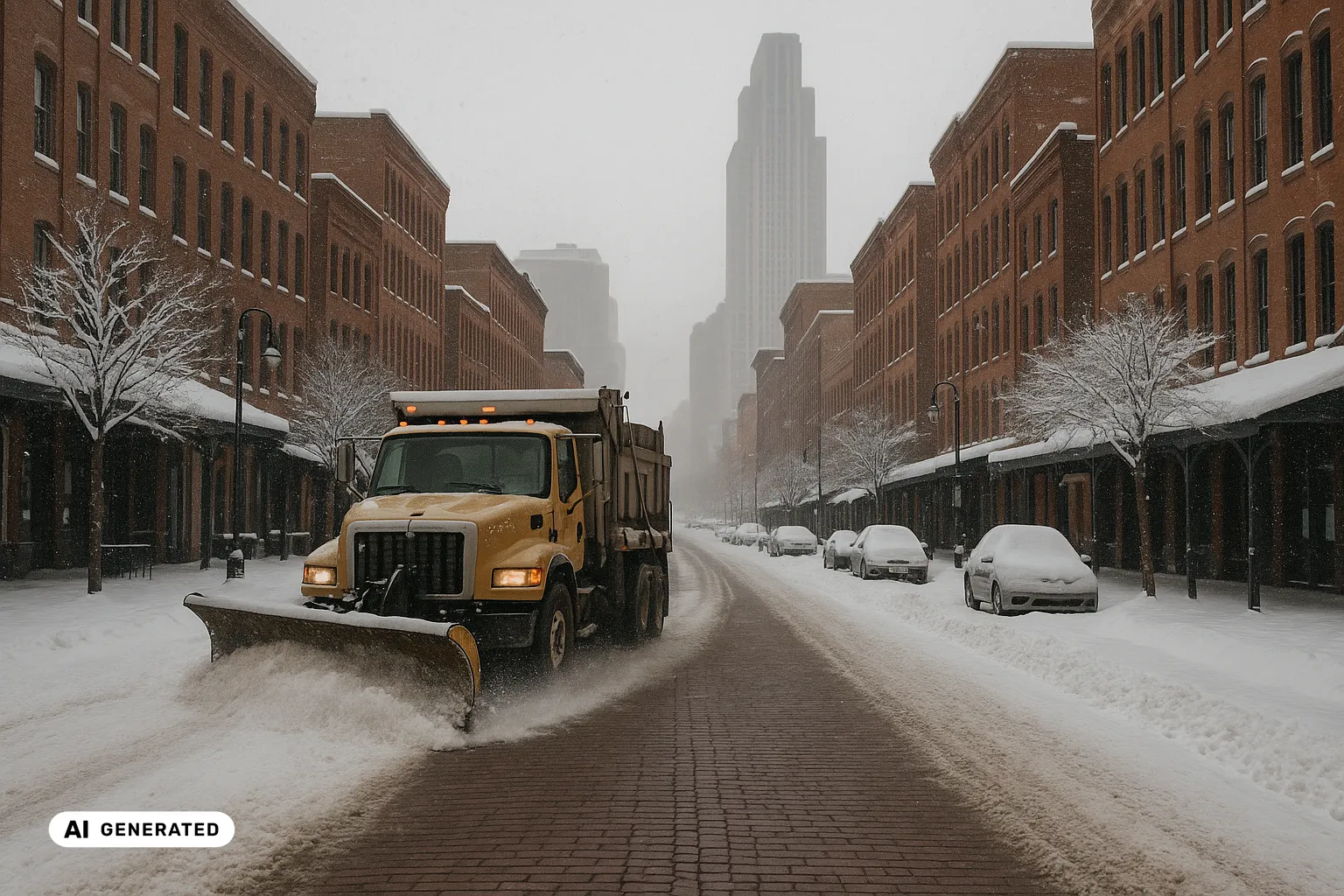
A clock that starts with an announcement
Most American sidewalk ordinances count from the weather. The snow stops, and a number of hours later the walk must be clear. Omaha’s counts from something else. Every autumn the city restates the duty in an annual public notice under Chapter 34, Article VI, Division 3 of the Omaha Municipal Code, and the words of Section 34-332 are these:
“It shall be the duty of the occupant, as well as the duty of the owner, of any lot or land or real estate in the city to clear all ice and snow from the sidewalks adjoining the said lot, land or real estate within 24 hours after the city has declared that snow removal operation on the city’s major streets are complete.”
Two things in that sentence are unusual. The duty falls on the occupant as well as the owner, so a tenant and a landlord are each bound. And the 24 hours begin with an administrative act — the city’s declaration that its major streets are done — not with the end of the snowfall. Until the city says so, the clock has not started; once it has, it runs on every lot in the city at the same moment.
Every neighbour does it the other way. Bellevue counts 24 hours from the end of the storm, Papillion five, Council Bluffs across the river 24 hours after a snowfall under Iowa law. Omaha alone ties the resident’s deadline to its own plowing. The rest of this page is about the city that wrote that rule: cold and windy more than snowy, plowed by two contractor markets at once, and cut down to its present grades by hand.
Twenty-seven inches, and only eight days of it
On the 1991–2020 normals at Eppley Airfield, Omaha records 27.1 inches (69 cm) of snow a season over 21.7 days with measurable snowfall. February is the snowiest month at 7.8 inches, just ahead of January’s 7.2 — a late peak for the Midwest, and a useful thing to know when contractors are deciding how long to keep crews on call.
The distribution matters more than the total. Omaha averages 8.4 days a year with an inch or more of new snow, 2.6 days with 3 inches or more — and 0.0 days with 10 inches or more. Big snow days are not part of the normal winter at all. When one comes, it comes as a single large portion: the record for one day at Eppley is 18.3 inches (46 cm) on 11 February 1965, and 25 January 2021 brought 11.9 inches.
What is not rare is cold. On an average of 40 days a year the temperature never rises above freezing, and the city has about 135 frosty nights. January averages a 34 °F high and a 15 °F (−9 °C) low. The record, in a series back to 1871, is −32 °F (−36 °C) on 5 January 1884. That is the shape of an Omaha winter: long stretches of frozen ground with ice to manage, punctuated by a handful of hard snow days — closer to Fargo’s winter of wind and cold than to a snowbelt city, with about half the snow.
One caveat on the station. Eppley Airfield lies in the Missouri bottoms at 984 ft (300 m), and since the river shifted its channel in 1877 it is surrounded on all four sides by Iowa. The city’s stated elevation is 1,060 ft (323 m), and the western suburbs sit higher still on the loess uplands. The climate record is a valley record; the city that reads it lives on the plateau above.
The storms that matter are the windy ones
Omaha’s reference storms are blizzards, and what they share is not depth but wind.
On 10 January 1975 a foot of snow fell on the city while sustained winds of 30 to 50 mph swept the region, with gusts of 70 to 90 mph. The temperature dropped from the mid-30s °F during the snow to 15 °F by the evening rush hour. Over a dozen people died in the Omaha area. The local weather history calls it “one of the biggest blizzards in the city’s history”.
December 2009 produced two. On 8–9 December Eppley measured 9.6 inches with a gust to 52 mph (84 km/h); two weeks later the Christmas blizzard of 23–26 December left snow depth at 14 inches — 10 from the new storm on top of 4 still lying from the first.
The older records set the ceiling: the winter of 1911/12 brought almost 70 inches, and March 1912 alone had 29.2 inches, more than a normal season. More typical is the storm of 8–9 January 2024, which the Omaha/Valley forecast office recorded at 3.5 to 5.0 inches across the city’s stations.
The hazard the city itself now names is not snow at all. Asked in November 2025 about the December 2024 ice storm, the city engineer explained that brine cannot be laid down before rain — it washes away — so the main preventive tool has no answer to freezing rain until it has already fallen.
A city cut down to plowable grades
Omaha rises from the river at about 980 ft to a dissected loess plateau on the west, and the climb used to be steeper. Early growth was held back by “the large, steep hills just west of downtown along Farnam, Douglas, and Dodge Streets”, which streetcars struggled to climb to the crest at 24th Street. From the 1880s to about 1920 the city cut them down: Farnam Street was lowered 45 feet (14 m) at 17th Street, and the intersection of 20th and Dodge stood 36 feet lower in 1920 than in 1880. Dodge Street’s grade was reduced from 12 % to 7 % in the 1920s.
Seven percent is still the steepest main approach to downtown, and Dodge is the city’s east–west spine, with reversible lanes between 30th and 69th Streets for the commuter peaks. Downtown the city pushes snow “to middle lanes where possible” rather than to the kerb, and in 2025/26 it said it would plow fewer lanes where streetcar construction had narrowed streets — 19th and Farnam was down to one.
Some ground the city does not touch. The interstates and West Dodge belong to the Nebraska Department of Transportation, whose winter driving page notes that “plows travel slowly, usually 25–30 miles per hour or less”. And the University of Nebraska Medical Center in Midtown states that its campus does not close during extreme weather — someone clears it through every blizzard.
Two hundred and twenty drivers, and eighteen contractors
The most detailed public account of how Omaha plows is an interview the city’s then assistant director of transportation gave in February 2024. The city works “with 5,000 miles of street” — against 675 lane miles in Council Bluffs — with approximately 220 plow drivers, 110 per 12-hour shift, on the arterials and snow routes. Residential streets are a different operation: 20 to 25 private contractors providing 175 to 200 additional drivers.
The trigger for those contractors is 2 inches (5 cm) of accumulation, lowered from 4 inches for the 2016/17 season. The goal is to finish within 12 hours of the end of accumulating snow. And the plan says when the goal applies: “normal winter weather” means roadway temperatures above 15 °F, winds under 20 mph (32 km/h) and snowfall under an inch an hour. Outside those conditions — which is to say, in every blizzard on this page — the timings are off. Columbus, Ohio still keeps a 4-inch threshold that leaves most residential streets untouched; Omaha moved off it a decade ago. The method is stated just as plainly: “95% of the job of snow and ice removal is moving it off the pavement”.
For 2025/26 the city told the council it had contracted 18 residential plow contractors, down from 22 to 24 in previous years, with the number liable to change through the season as subcontracts are arranged; salt and brine were fully stocked. Eighteen firms sharing the residential streets of a city of 489,000 is a substantial market. Chicago clears its side streets with its own fleet, down to garbage trucks fitted with plows; Omaha clears them with private trucks.
The second contractor market: sidewalks nobody cleared
The city does not clear sidewalks. When an owner has not, it has the walk cleared and sends the bill — and it buys that service by quadrant. On 31 July 2024 Omaha Public Works invited bids on four contracts, OPW 54820 to 54823, each for “2024-2025 Sidewalk Snow and Ice Removal” in one quadrant: Northeast, Southeast, Northwest, Southwest. A contractor here can be plowing residential streets for the city in the morning and, under a separate contract, clearing a private owner’s walk for the city in the afternoon.
The owner pays for the second job. The city’s notice sets the charge per linear foot of a standard five-foot-wide walk, at rates in the 2023 notice of $3.45 to $11.50 depending on snow depth, including a 15 % administrative charge. Repeat violations carry their own tariff: within 36 months, $150 for a second violation and $300 for the third and each one after. The notice adds that “Failure to comply is punishable under Omaha Municipal Code Section 1-10”, the code’s general penalty section, whose maximum this page does not quote.
Those rates are the post-2019 ones. In November 2018 the published tariff was $6, $8 and $10 per linear foot; the ordinance was amended the following year. Do not mix the two tables.
What keeps the system from being punitive is that it hardly runs on its own. The city has said so directly: “This isn’t something we want to do, this is completely complaint based.” Officials come out when someone reports a walk through the Mayor’s Hotline, by phone or online form, which routes snow reports to Public Works.
Where the snow may go is the one hard prohibition in the notice: it is unlawful “to place snow or ice upon any street or alley right-of-way from private driveways, sidewalks, lots, or other private property”.
Snow emergency: odd and even, east of 72nd Street
Omaha’s snow emergency is a parking regime, and it applies to a specific half of the city. When the city declares one — as it did from midnight on 1 February 2016, in a storm that also brought declarations in Bellevue, Council Bluffs and Gretna — parking is not allowed on snow routes, and on residential streets east of 72nd Street cars follow odd/even rules by house number. A car on the wrong side of a residential street can be ticketed; a car on a snow route can be towed. The city refers to Section 36-179 of the Municipal Code for the rule; the amount of the ticket is not something this page can state.
The 72nd Street line is not arbitrary. East of it is the pre-war grid — narrow lots, on-street parking, streets that can only be cleared kerb to kerb if the cars move. West of it are post-war subdivisions with driveways. Compared with the three-day rotation Minneapolis runs across its whole city, Omaha’s is a targeted rule for the part of town that needs it.
Across the river, a different state’s law
The metropolitan area spans eight counties, five in Nebraska and three in Iowa, with about a million residents. Crossing the I-480 bridge from downtown changes more than the city: it changes the source of the sidewalk duty.
In Council Bluffs the rule comes from Iowa Code 364.12, which — as the Iowa League of Cities summarises it — places “the onus of removing natural accumulations of snow and ice from sidewalks” on the abutting owner “within a reasonable time”, and lets the city clear it and “assess the cost to the property owner in the same manner as a property tax”. The city’s own guidance makes the reasonable time concrete: clear “within 24 hours of a snowfall”, “the full width of the sidewalk, down to the pavement”, and “It’s against the law to shovel snow into streets and alleys.” Its snow emergency is a parking ban from 7 p.m. on emergency snow routes “marked with blue signs”.
So one metro runs three clocks: Omaha’s from a city declaration, Council Bluffs’ from the snowfall, and Iowa’s statute underneath from “a reasonable time”. The airport, meanwhile, is reached through Carter Lake — an Iowa town — so even the drive to Eppley changes state on the way.
Sarpy County: five hours in Papillion, twenty-four in Bellevue
South of the city line the deadlines shorten. Bellevue, in a post by its police department citing Section 28-134 of the city code, requires that accumulations “shall be removed within 24 hours after cessation of any storm or snowfall”. The city leaves a notice and allows a further 24 hours; after that, according to KMTV, the charge runs to $150 to $350.
Papillion is stricter. Its Section 166-4 reads: “All sidewalks shall be cleaned within five hours after the cessation of a storm, unless the storm or fall of snow takes place during the night, in which case the sidewalk shall be cleaned before 8:30 a.m. the following day.” Its snow emergency starts at a number rather than a declaration — “when snow depth reaches two inches” — and every vehicle must leave the street.
La Vista declares its snow emergency at two inches or on the mayor’s announcement, after which parking is unlawful on any public street “for 24 hours or until the street has been plowed by the City snow plows”. Its sidewalk deadline, and Ralston’s, could not be verified for this page. The unincorporated county’s snow plan sends graders out at 2 inches, aims for 12 hours, and says of sidewalks what Omaha’s practice implies: “Manpower and budgets do not allow for the clearing of driveways and sidewalks.” Elkhorn, by contrast, has been inside Omaha since its annexation in 2007, and everything above about Omaha applies there.
Keeping a record of a deadline that starts with an announcement
Omaha turns a weather question into a records question. Because the sidewalk clock starts with the city’s declaration, the moment a walk becomes overdue is a date and time somebody announced, not a judgement about when the snow stopped. For a contractor clearing walks for a property manager, the useful record is three timestamps: when the city declared, when the crew attended, and what the walk looked like when they left.
Wintertrace is self-hosted software for recording winter service work: which site was attended, when, by whom, what material went down and how much, with the weather conditions of the shift captured automatically and a service record with GPS track, weather and photos you can produce months later. It runs on your own web hosting, without a subscription, and the data stays with you.
In a city where the plan itself says its timings stop applying above 20 mph of wind, a record of the conditions on the day — not just the work — is the part worth having.
A note on all of the above
This page is general information about winter service in Omaha, Nebraska, drawn from the city’s published material, its annual public notice restating Chapter 34 of the Omaha Municipal Code, and the neighbouring cities’ published rules as of September 2026. The ordinance wording is taken from the city’s official legal notices of October 2023 rather than from the codified text. It is not a substitute for legal advice, and it does not state what applies to any particular property. Cost-recovery rates, contractor numbers and snow emergency rules change from season to season — check the city’s current pages and the code text before relying on anything here.
Local facts
- About 27.1 inches (69 cm) of snow falls in an average season at Eppley Airfield on the 1991–2020 normals, over 21.7 days a year with measurable snowfall. February is the snowiest month at 7.8 inches, just ahead of January's 7.2.Source
- Big snow days are rare: on the same normals Omaha averages 8.4 days a year with an inch or more, 2.6 days with 3 inches or more, 1.2 days with 5 inches or more — and 0.0 days with 10 inches or more.Source
- The cold is the more persistent part of the winter: on an average of 40 days a year the temperature never rises above freezing, and the city has about 135 frosty nights. January averages a 34 °F high and a 15 °F low.Source
- The city's record low, in a series back to 1871, is −32 °F (−36 °C) on 5 January 1884. In the Eppley Airfield series since 1948 the low is −23 °F, reached three times: 10 January 1982, 22 December 1989 and 16 February 2021.Source
- The largest one-day snowfall at Eppley Airfield is 18.3 inches (46 cm) on 11 February 1965. The next in the series are 11.9 inches on 25 January 2021 and 7.5 inches on 23 February 2019.Source
- The snowiest winter in Omaha's history was 1911/12, with almost 70 inches between November and April; March 1912 alone brought 29.2 inches, more than a normal season, and remains the snowiest month on record.Source
- The blizzard of 10 January 1975 dropped a foot of snow on Omaha with sustained winds of 30–50 mph across the region and gusts to 70–90 mph; the temperature fell from the mid-30s °F to 15 °F by the evening rush hour, and over a dozen people died in the Omaha area.Source
- December 2009 brought two blizzards in one month: 9.6 inches at Eppley Airfield on 8–9 December with a gust to 52 mph, and a Christmas blizzard on 23–26 December that left 14 inches of snow depth in the city.Source
- The climate station sits in the river bottoms: Eppley Airfield lies at 984 ft (300 m), three miles northeast of downtown, and since an 1877 shift in the Missouri's channel it is surrounded on all four sides by Iowa. The city's stated elevation is 1,060 ft (323 m).Source
- Downtown's grades were cut by hand and steam shovel: between the 1880s and about 1920 Farnam Street was lowered 45 feet at 17th Street, and the intersection of 20th and Dodge stood 36 feet lower in 1920 than in 1880.Source
- Dodge Street's grade was reduced from 12 % to 7 % in the 1920s. Today it carries reversible lanes between 30th and 69th Streets, and from 96th Street West Dodge Road becomes a grade-separated expressway.Source
- The city's annual public notice states the sidewalk duty in these words: occupants and owners must clear all ice and snow from adjoining sidewalks 'within 24 hours after the city has declared that snow removal operation on the city's major streets are complete'. Failure to comply is punishable under Section 1-10 of the Municipal Code.Source
- If a walk is not cleared the city may have it done and bill the owner per linear foot, at rates in the 2023 notice of $3.45 to $11.50 depending on snow depth, including a 15 % administrative charge. Repeat violations within 36 months add $150 for the second and $300 for the third and each subsequent one.Source
- Sidewalk enforcement is complaint-driven, in the city's own words to KMTV: 'This isn't something we want to do, this is completely complaint based.'Source
- Before the ordinance was amended in 2019 the rates were $6, $8 and $10 per linear foot for 1–6, 6–12 and 12-plus inches; in November 2018 a local station calculated that a 50-foot walk left uncleared could cost around $300.Source
- In July 2024 Omaha Public Works invited bids on four contracts — OPW 54820 to 54823 — for '2024-2025 Sidewalk Snow and Ice Removal' in the Northeast, Southeast, Northwest and Southwest quadrants of the city.Source
- The city works 'with 5,000 miles of street', with approximately 220 plow drivers — 110 per 12-hour shift — plus 20 to 25 contractors providing 175 to 200 additional drivers, as the then assistant director of transportation described it in February 2024.Source
- Residential streets are plowed after 2 inches of accumulation, a threshold lowered from 4 inches for the 2016/17 season, with a goal of finishing within 12 hours of the end of accumulating snow. The plan defines 'normal winter weather' as roadway temperatures above 15 °F, winds under 20 mph and snowfall under an inch an hour.Source
- For the 2025/26 season the city contracted 18 residential plow contractors, compared with 22 to 24 in previous years; the number may change during the season depending on subcontracts. Salt and brine were reported fully stocked.Source
- In a declared snow emergency, parking is not allowed on snow routes, and residential streets east of 72nd Street follow odd/even rules by house number; a car on the wrong side may be ticketed on a residential street and towed on a snow route.Source
- The University of Nebraska Medical Center in Midtown states that 'the medical center campus does not close during extreme weather'.Source
- Bellevue counts from the weather, not from a declaration: under Section 28-134 accumulations 'shall be removed within 24 hours after cessation of any storm or snowfall'. Papillion's Section 166-4 allows five hours after a storm, or until 8:30 a.m. the next day for overnight snow.Source
- Across the river in Council Bluffs, Iowa Code 364.12 places the onus of removing snow and ice from sidewalks on the abutting owner 'within a reasonable time', and lets the city assess the cost 'in the same manner as a property tax'; the city itself asks for clearing within 24 hours of a snowfall.Source
- The Omaha–Council Bluffs metropolitan area spans eight counties, five in Nebraska and three in Iowa, with an estimated 1,009,836 residents in 2025 — 488,797 of them in Omaha and 62,690 in Council Bluffs.Source
- Nebraska DOT's Plow Tracker, launched on 22 January 2019, shows active state plows on the interstates and state highways with front-facing cameras and updates every minute; 'County and local entities manage other roads.'Source
Official contacts
Omaha Public Works — Snow Operations
The city's snow page: plowing priorities, the residential contractor areas, the snow emergency declaration and the odd/even parking rule.
City of Omaha — annual public notice on sidewalk snow removal (Omaha Daily Record)
The city's own legal notice restating Chapter 34, Article VI, Division 3: the 24-hour duty, the cost-recovery rates and the repeat penalties, in the ordinance's words.
Omaha Municipal Code — Chapter 34, Streets, Sidewalks and Public Places
The codified text, including Section 34-332. The site loads as an application, so it may take a moment to reach the section.
Mayor's Hotline — City of Omaha
The reporting channel for uncleared sidewalks, unplowed streets and potholes, by phone or online form; snow reports are routed to Public Works.
National Weather Service Omaha/Valley — Winter Weather
The forecast office for eastern Nebraska and south-west Iowa: warnings, winter safety and links to the Eppley Airfield climate record.
Nebraska Department of Transportation — Winter Driving
For the interstates and state highways through the metro, with the 511 road conditions service and the Plow Tracker.
Council Bluffs Public Works — Winter Weather Outreach
The Iowa side of the river: emergency snow routes on a map, and the city's sidewalk and parking rules.
Common questions about winter service in Omaha
- When exactly do I have to clear my sidewalk in Omaha?
- Later than you might assume, and on a clock you cannot read from the sky. The city's annual public notice restates the duty from Section 34-332 of the Omaha Municipal Code: occupants and owners must clear ice and snow from adjoining sidewalks 'within 24 hours after the city has declared that snow removal operation on the city's major streets are complete'. The trigger is that declaration, not the end of the snowfall. In practice the city announces it through its snow operations page, the Mayor's Hotline and local media once the arterials are finished, and the 24 hours run from there. If you want to know where you stand after a storm, the question to ask is not 'when did it stop snowing' but 'has the city declared the major streets complete'.
- I rent. Is the sidewalk my landlord's problem or mine?
- Both, as far as the ordinance is concerned. The text names 'the occupant, as well as … the owner' of the lot, so a tenant cannot point to the landlord and the landlord cannot point to the tenant — the duty sits on each of them. Who actually holds the shovel is a lease question, and worth settling in writing before the first storm, because the city's cost-recovery bill and any repeat penalty are addressed to the property, not to whoever forgot. For a property manager with several buildings east of 72nd Street, that also means one declaration by the city starts the same 24-hour clock on every one of them at once.
- What happens if the walk is not cleared?
- Two things, but only if someone complains. The city has told local reporters that sidewalk enforcement is 'completely complaint based' — crews are not patrolling for uncleared walks. When a complaint is made and the walk is still covered after the deadline, the city can have it cleared by one of its quadrant contractors and bill the owner per linear foot of a standard five-foot-wide walk, at rates the 2023 notice puts between $3.45 and $11.50 depending on depth, including a 15 % administrative charge. A second violation within 36 months adds $150 and a third or later one $300. Beyond that, the notice says failure to comply is punishable under Section 1-10, the code's general penalty section, whose amount this page does not quote.
- Where am I allowed to put the snow?
- Not in the street. The city's notice makes it unlawful 'to place snow or ice upon any street or alley right-of-way from private driveways, sidewalks, lots, or other private property'. The city's own sidewalk guidance, which could only be read second-hand for this page, is widely quoted as allowing snow between the back of the kerb and the sidewalk, on private property, or on part of the sidewalk itself provided a clear walking area at least four feet wide is kept. On the narrow lots east of 72nd Street that four feet is often the whole walk, which is why a lot of Omaha snow ends up on the front lawn.
- Why did the city move the residential plowing trigger from 4 inches to 2?
- Mainly because 4 inches is a rare event here. On the 1991–2020 normals Omaha sees only 2.6 days a year with 3 inches or more, so a 4-inch trigger meant most residential streets were never plowed at all in an average winter. The 2-inch trigger, in force since the 2016/17 season, brings the contractors out on the ordinary snow days — of which there are still only about eight a year with an inch or more. The 12-hour completion goal and the definition of 'normal winter weather' (roadway temperatures above 15 °F, wind under 20 mph, less than an inch an hour) came with it, so the city is explicit about when its own targets stop applying.
- Who is actually plowing my street?
- It depends where you live. Arterials and snow routes are plowed by city crews — about 220 drivers working 110 to a 12-hour shift, as of February 2024. Residential streets are handed to private contractors under seasonal agreements; the city had 20 to 25 of them with 175 to 200 drivers in early 2024 and contracted 18 for the 2025/26 season, a number it says may change with subcontracting. Both are working to the same 2-inch trigger and 12-hour goal. If the plow that comes down your street has a company name on the door rather than a city crest, that is the arrangement working as designed.
- What are the odd/even rules during a snow emergency?
- They apply to residential streets east of 72nd Street once the city declares a snow emergency, and they exist so the contractors can clear those older, narrower streets kerb to kerb. The published rule pairs the calendar with the house numbers: on an even-numbered date cars park on the even-numbered side, on an odd date on the odd side. During the February 2016 emergency the city put it as Tuesday for even numbers and Wednesday for odd, with tickets for cars on the wrong side and towing on the designated snow routes, where parking is not allowed at all. The city refers to Section 36-179 of the Municipal Code for the rule. The amount of the ticket is not something this page can state, and the rule does not apply west of 72nd, where the post-war subdivisions have driveways.
- Is a foot of snow the thing to plan for?
- Wind and ice are. A foot of snow in one storm has happened — 10 January 1975 is the reference, and 25 January 2021 brought 11.9 inches — but the normal mean shows 0.0 days a year with 10 inches or more. What the two defining blizzards share is not depth but wind: 30–50 mph sustained in 1975, a 52 mph gust at Eppley on 8 December 2009. The city's own plan says its timings assume winds under 20 mph, so a blizzard is by definition the day the plan does not hold. The other hazard is rain that freezes: after the December 2024 ice storm the city engineer explained that brine cannot be laid before rain, because the rain washes it away — the main preventive tool has no answer to that event.
- Does the snow ordinance apply in Elkhorn or Millard?
- Elkhorn does — it was annexed by Omaha in 2007, so the Omaha Municipal Code, the city's declaration trigger and the quadrant contracts all cover it, and it is plowed under the city's residential contractor arrangement rather than by a separate town crew. The picture changes at the Sarpy County line. Bellevue, Papillion, La Vista and Ralston each have their own codes with their own deadlines, and the unincorporated parts of Sarpy County are served by a county plan that plainly says 'Manpower and budgets do not allow for the clearing of driveways and sidewalks'. If a property sits near the county line, the first thing to check is which side of it the address is on.
- How different is it across the river in Council Bluffs?
- A different state's law, not just a different city's. In Iowa the sidewalk duty comes from Iowa Code 364.12, which puts the removal of natural accumulations of snow and ice on the abutting owner 'within a reasonable time' and allows the city to clear it and 'assess the cost to the property owner in the same manner as a property tax'. Council Bluffs itself asks for 24 hours after a snowfall, the full width of the walk down to the pavement, and prohibits shovelling into streets and alleys. Its snow emergency is a parking ban from 7 p.m. on routes marked with blue signs. Omaha's clock starts with a declaration; Council Bluffs' starts with the snow and ends, if it goes wrong, on the tax bill.
- Which roads does the city not plow at all?
- The interstates and state highways — I-80, I-480, I-680 and the West Dodge expressway among them — belong to the Nebraska Department of Transportation, whose Plow Tracker map shows active state plows with front cameras and refreshes every minute, and which notes that 'County and local entities manage other roads.' Sidewalks are not plowed by the city at all except as cost recovery against an owner who did not clear them. And some large sites keep their own crews: the University of Nebraska Medical Center in Midtown states that its campus does not close in extreme weather, which means someone is clearing it through every blizzard the city sits out.
Documenting winter service in Omaha
Anyone clearing snow and ice in Omaha may later need to show when and where a route was treated. Wintertrace is open-source software that records exactly that — time, location and weather for each run — as a calm basis for your own operational records and service proof. It is not a substitute for legal advice.
This overview is for general information and is not legal advice. Local rules on snow and ice clearing vary — the wording of the local rule and the responsible authority always govern.