Winter service · Ohio
Winter service in Columbus
What winter is really like in Columbus, Ohio: about 28.2 inches of snow a season against Cleveland's 63.8, but a January mean low of 21.97 °F that is practically identical, and 103 frost nights against 28.3 days with snow. Section 902.03 and its missing deadline, the 736 complaints that produced no citations, and why Priority 3 streets get a plow only above four inches and never any salt.
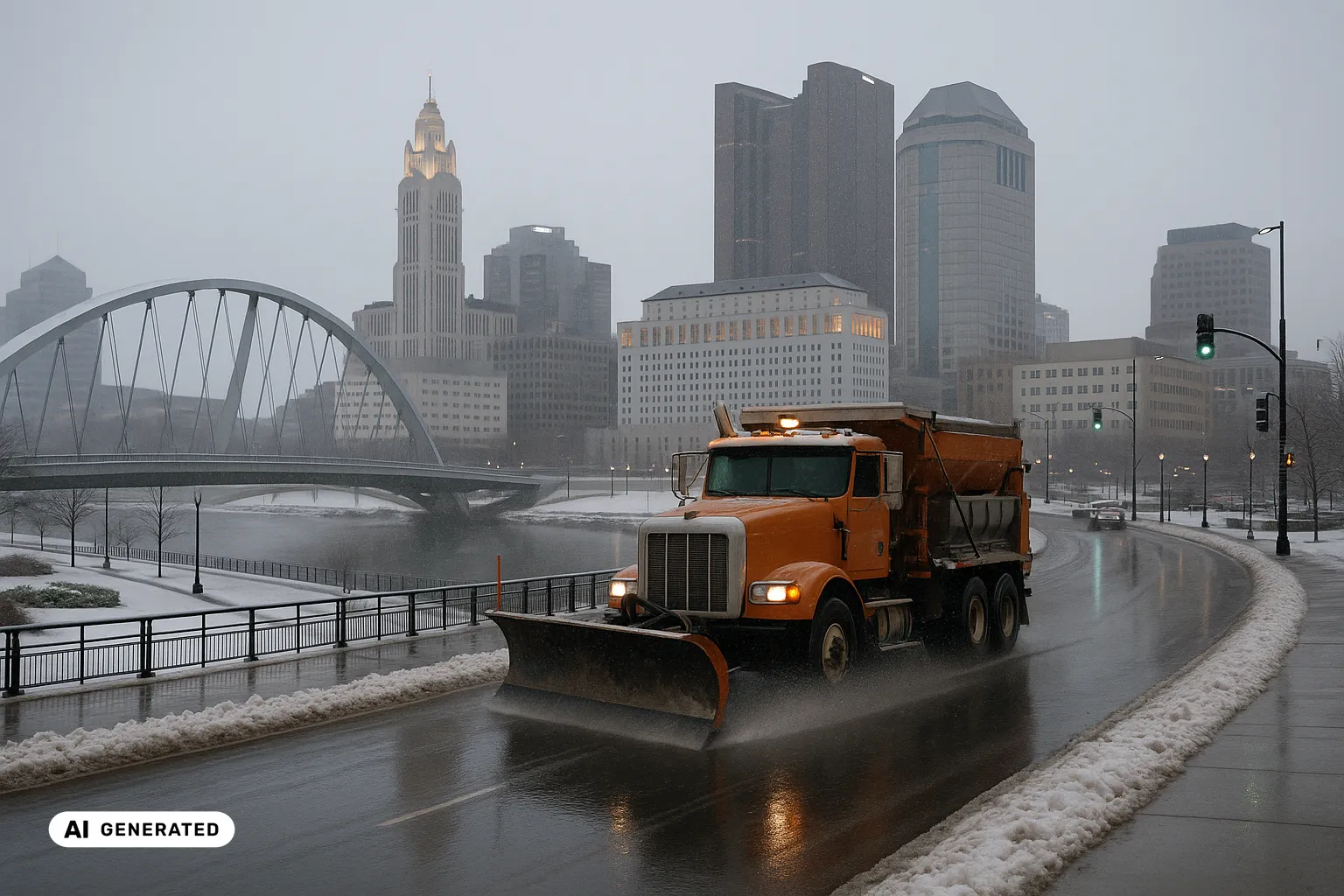
Ohio has two winters, and the drive between them takes about two hours.
Cleveland averages 63.8 inches of snow a season. Columbus, on the same 1991–2020 normals, from the same source, averages 28.2. Less than half. It is the single fact people reach for when they say the state capital does not really get winter.
The January numbers say something else. Cleveland’s mean January low is 22.3 °F. The National Weather Service gives Columbus 21.97 °F. A third of a degree apart. Whatever is different about winter here, it is not the cold.
Half the snow, the same cold
The reason Columbus stays out of the snow is geographical, and the published climate summary for the city puts it in one sentence: the city “is not in the typical path of strong winter lows, such as the Nor’easters that strike cities farther east”, and “is also too far south and west for lake-effect snow from Lake Erie to have much effect”.
Ohio’s snowfall gradient is steep. NOAA’s state summary records 60 inches or more a year along the southern shore of Lake Erie and under 16 inches in the south of the state. Columbus sits in the middle of it, and gets the middle number.
What it does get is frost. About 103 days a year have a low at or below 32 °F. About 28.3 days a year see at least a tenth of an inch of snow. For roughly three frosts in four, nothing falls at all.
And the mean January day here is not a cold day. It is a crossing day: it begins at 21.97 °F and reaches 37.19 °F. Every average January day in Columbus passes through freezing twice — once going up, once coming back down. That is the local winter in one line. Not depth. Transitions.
The forecast office for central Ohio is NWS Wilmington (ILN), not NWS Cleveland, and its event archive shows what those transitions produce. Of the December 2004 storm it records that “a band of severe icing fell just to the east of the heavy snow, affecting much of central and south Central Ohio”. Local reporting on the same event recalls six inches of snow in Columbus topped with an inch of ice, one to three inches of ice east of I-71, and power out for up to a week across central Ohio. In January and February 2011 the same office logged “significant ice accumulations” for central Ohio. In February 2022 it described precipitation that “fell as freezing rain, accreting on all surfaces, especially elevated ones such as trees and powerlines”, affecting locations near and north of I-70.
Columbus sits on I-70. When the forecast splits the state along that line, the city is on it.
One caution worth stating, because it would be easy to overclaim: there is no published source showing that central Ohio sees freezing rain more often than the north of the state, and this page does not say so. What the numbers and the event record do support is narrower and enough — Columbus spends its winter in the temperature band where precipitation can arrive as rain, sleet or freezing rain, and the documented events show what that costs when it does.
What the ordinance says, and what it leaves out
The rule is Columbus City Code § 902.03(a), last amended in 2023, and the operative words are these:
Every owner, occupant, or person having charge of any lot or parcel of land in the city shall cause the paved sidewalk or shared-use path, or any part thereof, in front of and abutting, or to the side or rear of and abutting upon such lot or parcel of land, to be clear of snow and ice each day.
Three things in that sentence are worth pulling out.
“Each day” is the deadline, and it is the only one there is. No hour. Compare Cleveland’s 9 a.m., or Worcester’s ten hours, or Chicago’s 10 p.m.. Columbus obliges you without telling you when. The city’s own guidance describes it as clearing “in a timely manner”, which is the same answer in different words.
“Owner, occupant, or person having charge” means the duty does not sit with the owner alone. A tenant can be the person responsible. So can a managing agent.
“Sidewalk or shared-use path” matters in a city with as much multi-use trail as this one. The obligation is not limited to the classic footway.
The subsection also builds in the answer for ice that will not come off: whatever remains must be covered “with such coating of sand or other substance as may be necessary to render travel safe and convenient”. In a city whose winter is mostly freeze-thaw rather than accumulation, that half-sentence is the operative one for much of the season.
And § 902.03(b) is the one commercial operators need: it prohibits placing or depositing snow or ice collected from parking lots, driveways, or any other private property onto a street, sidewalk, shared-use path, alley or right-of-way. Clearing a lot is not finished when the lot is clear.
The rule almost nobody is cited for
Here is the part that makes Columbus unusual, and it should be stated plainly rather than dressed up either way.
The Columbus City Attorney’s Office stated that nobody had been cited under this section of the city code in the past year, and that it could not recall earlier enforced violations. The theoretical penalty is a minor misdemeanour with a fine of up to $150; pushing snow onto the carriageway so that it impedes safe travel is treated more seriously.
That is not because nobody complains. In the 2025/26 season up to 12 February 2026, Columbus Building and Zoning Services had logged 736 complaints about snow and ice left on sidewalks or interior walkways. 265 of them ended with the walk cleared. None reached a courtroom.
What happens instead is a process with its own clock. A complaint through 311 brings a Code Enforcement inspection within 24 to 48 hours. If a violation is found, the notice gives the tenant, owner or manager five days to fix it, then there is a re-inspection and possibly a fresh notice with a fresh deadline. The deputy director of Building and Zoning Services described the approach without euphemism: “Going to court is a last ditch effort for us. If an owner can show some work toward compliance, we usually allow them additional time.”
So the ordinance says each day, and the enforcement path takes about a week to reach its first real lever. Both of those are true at once, and anyone maintaining property here should know both — the first because it is the standard, the second because it explains what actually happens on the street.
Four inches, and no salt
The city’s Snow & Ice Control Plan covers approximately 4,600 lane miles, in three priorities: about 1,490 lane miles of arterials, 1,180 of residential collectors, and 1,920 of local residential streets. Arterials are worked first and kept in service throughout an event; collectors follow once the arterials are in good condition; residential streets come last, “when warranted by a significant snow/ice event”. While Columbus City Schools is in session, streets around schools are a top priority.
Then the two sentences that decide what most people actually experience:
Residential streets (Priority 3) are plowed when significant snowfall of 4 inches or more occurs.
Residential streets (Priority 3) are serviced by plow only and no salt is used.
Set that against a January snowfall normal of 9.5 inches for the entire month. The four-inch threshold is not crossed often. For 1,920 lane miles of the city — the largest single share of the network — the winter service position is, by published policy, no salt at all and a plow only above a threshold that many storms never reach.
That is not a criticism of the city; it is a rational allocation for a place with 28 inches of snow. But it is the fact that matters most to a property manager or a contractor here, because it means the treatment of a residential street frontage is, in practice, a private matter.
The city is honest about the target, too. Its plan defines success not as bare pavement but as passable roadways — “roadway conditions that allow for traffic movement on a safe driving surface, with a reasonable amount of inconvenience due to current and recent weather conditions”.
Where the city does treat, it pre-treats: crews apply anti-icing liquids ahead of a forecast event to keep snow and ice from bonding to the pavement, using salt, beet juice and liquid calcium chloride. The plan gives the reason in one line — salt alone is effective to about 15 °F, and the additives push that down toward 5 °F. With a January mean low of 21.97 °F and a record of −22 °F, that margin gets used.
For anyone who wants to know whether a specific street has been serviced, the city runs Warrior Watch, a public tracker showing snow and ice service activity for the past 72 hours, searchable by address, with the map updated every minute. It is a considerably longer look-back than most cities publish.
Two kinds of snow emergency
Columbus has no seasonal odd-even parking regime. It has an event-based declaration — and, separately, a county system. They are different things.
The city’s own runs under Chapter 2157. The Mayor declares it, and the trigger is worth reading in a city like this one: two inches of snow in a short period with the prospect of more, or an accumulation of ice that impairs the safe movement of vehicular traffic. Ice stands on equal footing with snow in the definition, which is exactly right for the climate described above.
Once declared, it is announced through local media, and vehicle owners are treated as informed two hours after the official announcement. From then, stopping or leaving a vehicle on a street designated for snow removal — or posted “No Stopping During Snow Emergency”, as the arterials are — is a parking infraction. The police may have the vehicle removed, and the owner is responsible for all towing and storage costs. The chapter’s penalty section was repealed in 2003, so the sanction is not a fine. It is the tow.
The Franklin County Sheriff separately declares snow emergency levels 1, 2 and 3 for county and township roads, resting on Ohio Attorney General opinions 86-023 and 97-015. Level 3 closes roads to everyone but emergency personnel. A level-3 county declaration and a city snow emergency are not the same instrument and do not necessarily arrive together.
Across the Outerbelt
I-270, the Outerbelt, runs 54.97 miles around the city, and it is a good mental marker for something that catches people out: the rules change on the other side of it, and generally they get stricter.
Grove City requires the owner, occupant or person having care of a property to remove snow “within the first four hours after daylight” following or during a snowfall, and to remove or sand ice in the same window. Each day counts as a separate offence. That section dates from 1974 — Grove City has had a hard deadline for over half a century while the capital next door has never set one.
Worthington gives 12 hours of daylight after a snowfall or an ice accumulation, and adds the lever Columbus lacks: if the owner has not complied within 24 hours of a formal notice, the City may have the sidewalk cleared and bill the property owner.
Westerville imposes a duty with no stated deadline. Dublin clears some paths itself, including those determined to be high-traffic routes for schools, and prohibits depositing snow on any public sidewalk, street, bike path or road.
And Upper Arlington goes the other way entirely: its winter page states that residents are encouraged to keep their sidewalks clear. No duty at all. It does, though, give residential streets a service target of roughly 12 to 24 hours after precipitation ends — where Columbus gives residential streets a four-inch threshold and no salt. On one side of a boundary line, a timed commitment to plough the street and a polite suggestion about the walk. On the other, a legal duty on the walk that nobody is cited for, and a street that may not be touched.
The storm does not notice the boundary. A route that crosses it works under two rulebooks in one shift.
Keeping the record straight
In a city that says “each day” and names no hour, that writes sanding into the ordinance as a lawful answer to ice, and where 1,920 lane miles of residential street get a plow only above four inches and no salt at any depth, the useful thing is being able to show plainly what was done and when.
Not to win an argument. Because 103 frost nights against 28 snow days produces exactly the questions a vague answer cannot settle: was this frontage treated on the day, was it sanded or cleared, what was the surface doing when the crew was there, and where did the snow from the car park end up. A simple, time-stamped record of each treatment, set against what the weather was actually doing, turns “we treated it that morning” into something specific — a clear service record whether you look after one frontage in German Village or a route that runs out past the Outerbelt into Grove City’s four-hour rule.
That is the documentation support Wintertrace is built to make easy. It does not change any local rule, and it is not a substitute for legal advice. It just means that when someone asks what happened during the last freeze, the answer is on file.
Local facts
- Columbus averages about 28.2 inches of snow a season at John Glenn Columbus International Airport on the 1991–2020 normals. Cleveland Hopkins, in the same state, on the same normals, from the same source, averages 63.8. Columbus gets roughly 44 per cent of the snow its northern neighbour does.Source
- The cold, however, is nearly the same. The National Weather Service office at Wilmington gives the January normals for Columbus as a maximum of 37.19 °F and a minimum of 21.97 °F. Cleveland's January mean low is 22.3 °F. The two cities are a third of a degree apart.Source
- That January pair is the whole argument: the mean January day here starts at 21.97 °F (−5.6 °C) and ends at 37.19 °F (2.9 °C). The average day crosses freezing twice.Source
- Columbus records about 103 days a year with a low at or below 32 °F, but only about 28.3 days a year with at least 0.1 inches of snowfall. For roughly three out of four frosts, no snow falls at all — what is left is dry frost, rime or freezing wet.Source
- The reason is geographical, and the published climate summary for the city states it plainly: Columbus "is not in the typical path of strong winter lows, such as the Nor'easters that strike cities farther east" and "is also too far south and west for lake-effect snow from Lake Erie to have much effect".Source
- It sits in the middle of a steep statewide gradient. NOAA's state climate summary for Ohio notes that the northern portion along the southern shores of Lake Erie receives 60 inches or more annually, while the southern portion receives less than 16.Source
- The forecast office for Columbus is NWS Wilmington (ILN), not NWS Cleveland — and its event archive shows what freezing rain does here. Of the December 2004 storm it records that "a band of severe icing fell just to the east of the heavy snow, affecting much of central and south Central Ohio".Source
- In February 2022 the same office described precipitation that "fell as freezing rain, accreting on all surfaces, especially elevated ones such as trees and powerlines", affecting locations near and north of I-70. Columbus sits on I-70 — regularly on the line itself between rain and freezing rain.Source
- Under Columbus City Code § 902.03(a), "every owner, occupant, or person having charge of any lot or parcel of land in the city shall cause the paved sidewalk or shared-use path ... to be clear of snow and ice each day." The duty covers shared-use paths as well as sidewalks, and it names occupants and persons in charge alongside owners.Source
- The same subsection allows sanding as a substitute where clearing is impossible: whatever ice remains must be covered "with such coating of sand or other substance as may be necessary to render travel safe and convenient".Source
- Section 902.03(b) prohibits placing or depositing snow or ice collected from parking lots, driveways or any other private property onto a street, sidewalk, shared-use path, alley or right-of-way — which makes it a rule about commercial lot clearing as much as about households.Source
- The duty is, in practice, not enforced through the courts. The Columbus City Attorney's Office stated that nobody had been cited under this section of the city code in the past year, and that it could not recall earlier enforced violations.Source
- That is not for lack of complaints. As of 12 February 2026, Columbus Building and Zoning Services had received 736 complaints about uncleared snow and ice on sidewalks or interior walkways that season, of which 265 ended in compliance. None went to court. Deputy Director Anthony Celebrezze: "Going to court is a last ditch effort for us."Source
- The city's published Snow & Ice Control Plan covers approximately 4,600 lane miles, split into about 1,490 lane miles of arterials (Priority 1), 1,180 of residential collectors (Priority 2) and 1,920 of local residential streets (Priority 3).Source (PDF)
- The plan states that "residential streets (Priority 3) are plowed when significant snowfall of 4 inches or more occurs", and that they "are serviced by plow only and no salt is used". With a January snowfall normal of 9.5 inches, that threshold is not reached often.Source (PDF)
- The city defines its own target honestly, and downward. "Passable Roadways are defined as roadway conditions that allow for traffic movement on a safe driving surface, with a reasonable amount of inconvenience due to current and recent weather conditions." Not bare pavement.Source (PDF)
- Anti-icing here runs on salt, beet juice and liquid calcium chloride. The plan notes that "salt alone is effective to 15 degrees Fahrenheit", with the additives extending that to around 5 °F — which matters in a city whose January mean low is 21.97 °F and whose record low is −22 °F.Source (PDF)
- Warrior Watch, the city's public plow tracker, shows snow and ice service activity for the past 72 hours, is searchable by address, and states that the service activity displayed on the map is updated every minute.Source
- A snow emergency here is declared by the Mayor, and the trigger names ice on equal footing with snow: two inches of snow in a short period with the prospect of more, or an accumulation of ice that impairs the safe movement of vehicular traffic.Source
- During a declared emergency, stopping or leaving a vehicle on a street designated for snow removal or posted as a no-stopping zone is a parking infraction; police may have the vehicle removed and the owner is responsible for all towing and storage costs. The chapter's own penalty section was repealed in 2003 — the sanction is the tow.Source
- Just outside the city line, the rules get sharper. Grove City § 521.06 requires snow to be removed "within the first four hours after daylight", allows ice to be removed or sanded in the same window, and provides that "a separate offense shall be deemed committed each day during or on which a violation occurs or continues". The section dates from 1974.Source
- Worthington gives property owners 12 hours of daylight after a snowfall or ice accumulation, and states that if an owner does not comply within 24 hours of a formal notice, the City may have the sidewalk cleared and bill the owner for it.Source
- Upper Arlington, on the other side of the city, does not impose the duty at all: its winter page states that residents are encouraged to keep their sidewalks clear of snow and ice. It does, however, give residential streets a service target of roughly 12 to 24 hours after precipitation ends — where Columbus gives them a four-inch threshold.Source
Official contacts
City of Columbus — Warrior Watch plow tracker and Snow & Ice Control Plan
The published plan with the lane-mile figures, the priority definitions, the four-inch residential threshold and the "passable roadways" target — plus the live tracker showing service activity over the last 72 hours.
Columbus City Code § 902.03 — sidewalks, shared-use paths and streets
The ordinance text itself: the "each day" duty, who it binds, the sanding alternative, and the prohibition on depositing lot and driveway snow in the public right-of-way.
City of Columbus 311 — reporting an uncleared sidewalk
Complaints go through the city's 311 line on 614-645-3111 or 311@columbus.gov. Code Enforcement inspects within 24 to 48 hours, then allows five days to put it right.
NWS Wilmington (ILN) — climate normals for Columbus
The forecast office responsible for central Ohio, and the source of the January normals used on this page. Its event archive also documents the region's significant ice storms.
Franklin County Sheriff — snow emergency levels
The county-level system that operates alongside the city's own declaration, and the page that carries whichever level is currently in force.
Common questions about winter service in Columbus
- Do I have to clear my sidewalk in Columbus, and by when?
- Yes — the duty is real, but there is no hour attached to it. Columbus City Code § 902.03(a) requires every owner, occupant or person having charge of a lot to keep the abutting paved sidewalk or shared-use path clear of snow and ice "each day". That is a genuine obligation and it binds tenants and managing agents as well as owners, but it is not Cleveland's 9 a.m. or Grove City's four hours after daylight. The city's own guidance describes it as clearing "in a timely manner". If clearing is impossible, the same subsection allows you to cover what remains with sand or another substance sufficient to make travel safe and convenient. This is general information rather than legal advice; the ordinance text is published and worth reading for your own frontage.
- What happens if I don't?
- In theory a minor misdemeanour with a fine of up to $150. In practice, almost certainly nothing through the courts: the Columbus City Attorney's Office stated that nobody had been cited under this section in the past year and that it could not recall earlier enforced violations. What does happen is administrative. A 311 complaint brings a Code Enforcement inspection within 24 to 48 hours, then a notice giving five days to put it right, then a re-inspection. In the 2025/26 season up to 12 February, 736 complaints produced 265 cases of compliance and no court cases. The deputy director of Building and Zoning Services put the approach directly: "Going to court is a last ditch effort for us. If an owner can show some work toward compliance, we usually allow them additional time."
- Why does Columbus get so much less snow than Cleveland, and does it matter?
- Because it is out of reach of both mechanisms that bury the north-east. The published climate summary for the city states that Columbus is not in the typical path of the strong winter lows that strike cities farther east, and is too far south and west for lake-effect snow off Lake Erie to have much effect. Ohio's statewide gradient runs from 60 inches or more along the Erie shore to under 16 inches in the south; Columbus sits in the middle of it at 28.2. Whether it matters depends on what you are measuring. Snow, no. Cold, very much: the January mean low here is 21.97 °F against Cleveland's 22.3 °F, and there are about 103 frost nights a year against only 28.3 days with measurable snow. The hazard in Columbus is what happens on the roughly three frosts in four that arrive without snow.
- When will my residential street be plowed?
- Possibly not at all, and that is written policy rather than an oversight. The city's Snow & Ice Control Plan states that Priority 3 residential streets — about 1,920 of the roughly 4,600 lane miles — are plowed when significant snowfall of four inches or more occurs, and that they are serviced by plow only, with no salt used. The January snowfall normal for the whole month is 9.5 inches, so in many winters that threshold is crossed rarely. Arterials come first and are worked throughout an event, then collectors, then residential streets if the event warrants it. Streets around Columbus City Schools are a top priority while school is in session. You can check what has actually been serviced near an address on the city's Warrior Watch tracker, which shows the last 72 hours and updates every minute.
- What is a snow emergency here, and where can't I park?
- There are two separate systems and they are easy to confuse. The city's own is declared by the Mayor under Chapter 2157, and the trigger names ice alongside snow: two inches of snow in a short period with more expected, or ice accumulated enough to impair the safe movement of vehicular traffic. Once it is announced, vehicle owners are treated as informed two hours later. Stopping or leaving a vehicle on a street designated for snow removal or posted "No Stopping During Snow Emergency" is then a parking infraction, and police may have the vehicle removed with the owner paying all towing and storage costs — the chapter's penalty section was repealed in 2003, so the tow is the sanction. Separately, the Franklin County Sheriff declares county-wide snow emergency levels 1 to 3, with level 3 closing roads to all but emergency personnel. Those levels apply to county and township roads and are not the same thing as the city's declaration.
- Do the suburbs have the same rules?
- No, and the differences inside one county are large. Grove City requires clearing within the first four hours after daylight, treats each day as a separate offence, and has had that rule on the books since 1974. Worthington allows 12 hours of daylight, and if an owner has not complied within 24 hours of a formal notice the City may clear the walk and bill for it. Westerville imposes a duty with no stated deadline. Upper Arlington does not impose one at all — it encourages residents to clear their walks — but gives residential streets a service target of about 12 to 24 hours after precipitation ends, which Columbus does not. Dublin clears some paths itself, including routes determined to be high-traffic for schools. If a route crosses the Outerbelt, it crosses into a different rulebook.
Documenting winter service in Columbus
Anyone clearing snow and ice in Columbus may later need to show when and where a route was treated. Wintertrace is open-source software that records exactly that — time, location and weather for each run — as a calm basis for your own operational records and service proof. It is not a substitute for legal advice.
This overview is for general information and is not legal advice. Local rules on snow and ice clearing vary — the wording of the local rule and the responsible authority always govern.