Winter service · Alaska
Winter service in Anchorage
What winter is really like in Anchorage: a subarctic city at 61°N with about 74.5 inches of snow a year, months of unbroken snowpack, and a genuinely unusual split of who clears what — the Municipality, the State of Alaska and private Road Service Areas each plow different roads. The Bowl-to-Hillside snow gradient, the depth-based plow-out schedule, the driveway-berm 'gate' graders, and Anchorage Municipal Code 24.80.090.
What winter actually does in Anchorage
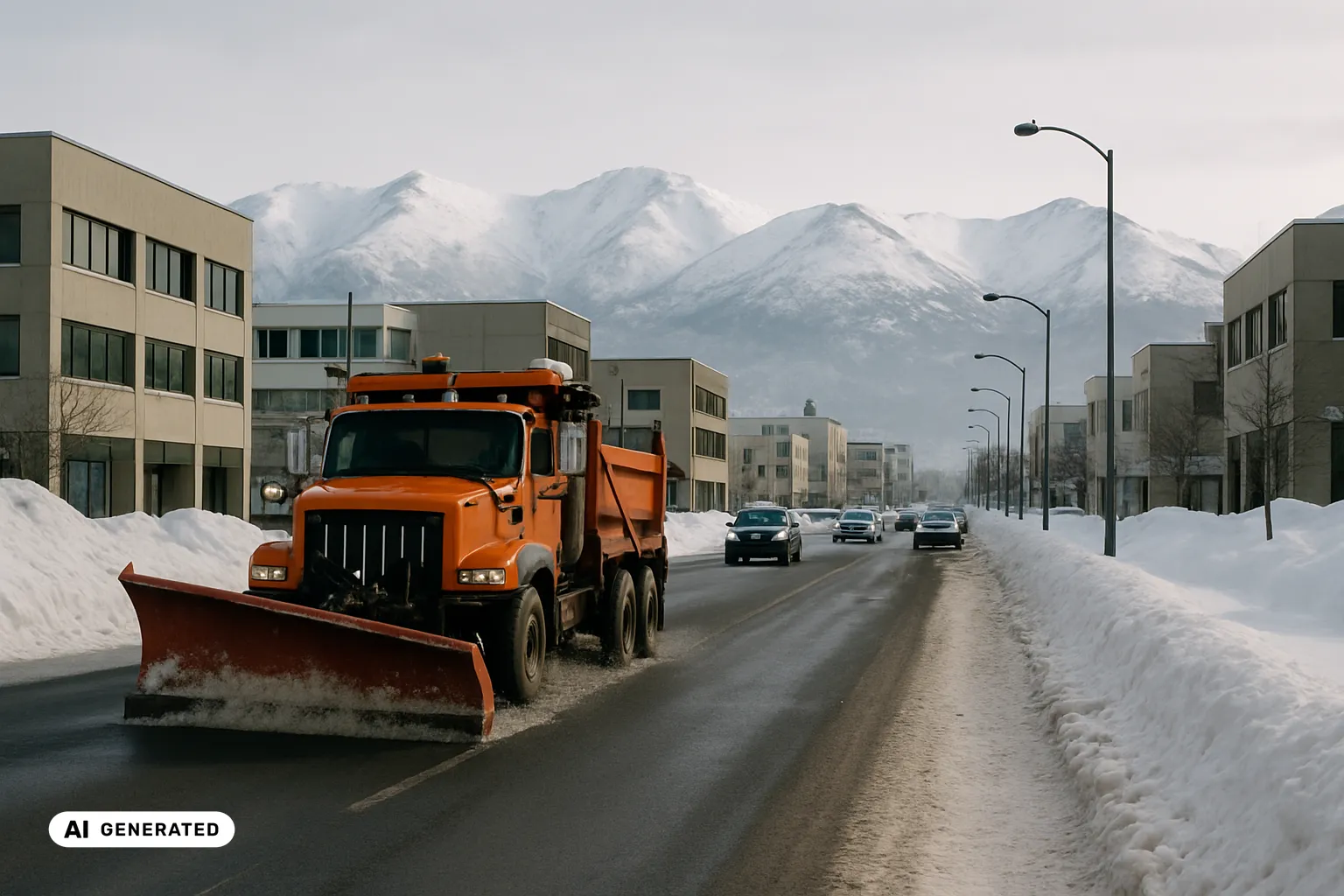
Anchorage sits in the Anchorage Bowl, a coastal lowland caught between the Chugach Mountains to the east and Cook Inlet — its Knik and Turnagain Arms — to the west and south. At 61° north, the winter days are very short, and the snow, once it arrives, does not go away for a long time. That combination of subarctic latitude, mountains and inlet is most of the explanation for an Anchorage winter.
The snowfall numbers depend on which you trust. The National Weather Service puts the normal season at about 74.5 inches; the Municipality’s own plan says the city has historically averaged nearer 60, while the two winters before 2024–25 averaged over 120. Year to year the swing is huge — a record 134.5 inches in 2011–12, as little as 25.1 in 2014–15. But the number that shapes the work is duration: at this latitude the snow stays, once for 196 consecutive days, with a January that averages around 10 °F (−12 °C). This is less a series of storms to clean up than a whole winter’s snowpack to manage from October to May.
The Bowl and the Hillside
Even within the city, the snow is not evenly shared, and the reason is elevation. The airport, the climate station, sits near sea level at about 125 feet; the Hillside neighbourhoods climb steeply into the Chugach foothills, where a reference weather station stands at about 1,910 feet. That rise drives a real snow gradient: the higher ground reliably takes more snow than the Bowl below, on steeper streets. It is the same mechanism — a valley floor and the slopes above it — that shapes Salt Lake City far to the south, and it means a single Anchorage snowfall figure can badly understate what fell up the Hillside.
Alaska’s other winter city inverts this. In Fairbanks, in the Interior, the hills are the warm side: cold air pools on the valley floor hard enough that a house up on the ridge can average some 16 °F warmer than the valley below it. Anchorage’s gradient is about snow. Fairbanks’s is about temperature — which is why the city there spreads rock chips instead of salt.
Who clears what — the part that surprises people
The most distinctive fact about winter service in Anchorage is not the snow. It is that three different kinds of organisation plow different roads, and knowing which one owns a given street is half the battle.
The Municipality’s Street Maintenance division does the core job: working October through May, 24/7, it clears over 680 miles of road — about 1,408 lane miles — plus 176.6 miles of sidewalk and 13 miles of trail. But many of the busiest roads are not the Municipality’s. The State of Alaska (Alaska DOT&PF) plows the Glenn and Seward Highways and major arterials such as Tudor, Benson, C Street and Fireweed Lane. And whole residential areas belong to neither: the Hillside, Eagle River and Girdwood are served by private Road Service Areas that contract their own snow removal, while downtown sidewalks are cleared by the Anchorage Downtown Partnership. So “the city plows the streets” is only partly true — a real, everyday coordination fact here.
What the local rules say
For property owners, the duty sits in Anchorage Municipal Code 24.80.090. As the code is framed, an occupant of land adjacent to a public sidewalk is responsible for removing accumulated snow and removing or treating ice, with the duty applying between 8 a.m. and 6 p.m. Snow from a driveway or lot may not be pushed into the street right-of-way or onto sidewalks — the Municipality flatly calls that illegal, and notes it “makes it harder for plow operators to do their job.”
Because much of the city’s residential sidewalk network is not cleared by the Municipality at all — by its own account it has historically not cleared most neighbourhood sidewalks, needing to use the sidewalks to store snow — the occupant’s duty and the plow plan sit side by side rather than overlapping. None of this is legal advice; it is simply what the code and the plan say. The exact wording is in the ordinance, so read it rather than a summary.
How the plowing runs — depth, deadlines and the berm
The Municipality plows by depth, not by the clock alone. Under 4 inches, it does main routes only; from 4 to 15 inches, main routes and then neighbourhood streets; over 15 inches, crews adapt to circumstances. Residential plow-out is measured from when the main roads are finished, with targets running from about 84 hours (for a 4-to-6-inch storm) up to 120 hours or more (for over 15 inches), worked zone by zone on an alternating A/B schedule. So a quiet residential street can wait days after a big storm while the arterials stay open. Downtown is the exception: a 48-hour target, night plowing with immediate hauling, and no on-street parking from 2 to 6 a.m. so crews can work.
Then there is the berm — and Anchorage’s answer to it. Normally a passing plow leaves a ridge of snow across every driveway for the owner to dig out. Anchorage fights that directly: its graders are fitted with “gates” that keep the blade from dumping snow across driveways, and the Municipality claims no other government in the US or Canada uses gates to the same degree — at a cost of roughly 30% more plowing time. Residents who still cannot clear a berm, for reasons of age or disability, can request berm removal. It is a small, very Anchorage detail that tells you how central the driveway-berm problem is to a subarctic winter.
The highways, the arms, and the boroughs beyond
Around the Bowl, the winter map keeps splitting. The Glenn and Seward Highways — the main ways in and out — are State-maintained, and the Seward Highway along Turnagain Arm is known for wind, glaze and avalanche exposure. To the north, Eagle River, and to the south along the arm, Girdwood, sit inside the Municipality but run on their own Road Service Areas. Beyond the city entirely, the Mat-Su Borough (Wasilla and Palmer) is a separate jurisdiction again, forecast by the Weather Service as its own area. The lesson for anyone doing winter service here is the same one the whole city teaches: check who owns the road before you assume who clears it.
Keeping the record straight
In a city where the Municipality, the State and a private road district may all be plowing within a few blocks, and where a residential street can legitimately wait days, the useful thing is being able to show, plainly, what was done and when. Not to win an argument, but because a winter this long and this divided generates exactly the questions — was the route cleared, at what time, in what conditions — that a vague answer can’t settle. A simple, time-stamped log of where a crew went and when, and an honest record of the hours worked against what the weather was actually doing, turns “we were out all week” into something specific. That is the documentation support Wintertrace is built to make easy, whether you run a municipal-style operation or a single route on the Hillside. It does not change any local rule or who owns which road; it just means that when someone asks what happened during the last storm, the answer is on file. Not a substitute for legal advice.
Local facts
- The normal seasonal snowfall at Ted Stevens Anchorage International Airport is about 74.5 inches (around 189 cm), according to the National Weather Service — though the city's own plan notes it has historically averaged nearer 60 inches, while the two winters before 2024–25 averaged over 120.Source (PDF)
- Anchorage winters vary enormously year to year: the snowiest season on record was 2011–12 with 134.5 inches, the least snowy 2014–15 with just 25.1 inches, and the deepest snow on the ground reached 47 inches at the turn of 1955–56.Source (PDF)
- The snow stays: at 61° north, Anchorage once held at least half an inch of snow on the ground for 196 consecutive days (October 1971 to May 1972), and January, the coldest month, has an average low around 10 °F (−12 °C).Source (PDF)
- The city sits in the Anchorage Bowl between the Chugach Mountains and Cook Inlet, and the ground climbs sharply from the airport near sea level (about 125 feet) up into the Hillside neighbourhoods — a reference weather station on the Hillside stands at about 1,910 feet — so higher ground reliably takes more snow than the Bowl.Source
- Under Anchorage Municipal Code 24.80.090, an occupant of land adjacent to a public sidewalk is responsible for removing accumulated snow and removing or treating ice, with the duty applying between the hours of 8 a.m. and 6 p.m.Source
- The Municipality's Street Maintenance crews work October through May, twenty-four hours a day, seven days a week, and clear over 680 miles of road (about 1,408 lane miles) plus 176.6 miles of sidewalk and 13 miles of trail.Source (PDF)
- Plowing is prioritised by depth: under 4 inches, main routes only; 4 to 15 inches, main routes and then neighbourhood streets; over 15 inches, crews adapt to circumstances — and residential plow-out targets run from 84 hours (for 4–6 inches) up to 120 hours or more (for over 15 inches) after the main roads are done.Source (PDF)
- Many of Anchorage's busiest roads are not the Municipality's at all: the State of Alaska (Alaska DOT&PF) plows the Glenn and Seward Highways and major arterials such as Tudor, Benson, C Street and Fireweed Lane — so 'the city' does not clear everything.Source (PDF)
- Whole areas are cleared by neither the Municipality nor the State: the Hillside, Eagle River and Girdwood are served by private Road Service Areas that contract their own snow removal, and downtown sidewalks are cleared by the Anchorage Downtown Partnership.Source (PDF)
- Anchorage's graders use 'gates' that keep the plowed snow from being dumped across driveways — the Municipality says no other government in the United States or Canada uses gates to the same degree, though it adds about 30% to plowing time — and residents who cannot clear the berm can request berm removal.Source (PDF)
Official contacts
Municipality of Anchorage — Winter Maintenance
The Street Maintenance hub: the October–May 24/7 operation, what the owner is responsible for, and how to report snow issues.
Municipality of Anchorage — Snow & Ice Control Plan (PDF)
The full plan: the depth-based priorities, plow-out deadlines, the shared-responsibility map (Municipality, State, Road Service Areas), the fleet, and the 'gate' grader system.
Anchorage Municipal Code 24.80.090 — snow and ice removal from sidewalks
The ordinance setting the occupant's duty to clear adjacent public sidewalks and treat ice, and the 8 a.m.–6 p.m. window.
Anchorage Downtown Partnership — sidewalk snow removal
Who clears the downtown sidewalks — a separate body from the Municipality's street crews.
Common questions about winter service in Anchorage
- Do I have to clear the sidewalk in front of my property in Anchorage?
- If your property adjoins a public sidewalk, yes. Under Anchorage Municipal Code 24.80.090, an occupant of land adjacent to a public sidewalk is responsible for removing accumulated snow and removing or treating ice, and the duty applies between 8 a.m. and 6 p.m. Snow from your driveway or lot may not be pushed into the street right-of-way or onto sidewalks — the Municipality calls that illegal and says it makes the plow operators' job harder. This is general information, not a substitute for legal advice; the exact wording is in the code, so read the ordinance itself rather than a summary.
- Why does the Municipality never seem to plow my neighbourhood sidewalk?
- Because, by its own account, it historically has not cleared most neighbourhood sidewalks — and there is a concrete reason. As the Snow & Ice Control Plan puts it, given the cost of hauling and the design of the roads, the Municipality has to use the sidewalks to store snow. Street Maintenance plows the Municipally owned roads and the sidewalks along main roads; many residential walks are left, and downtown walks are handled separately by the Anchorage Downtown Partnership. It is one of the things that surprises newcomers: 'the city plows the streets' does not mean it clears every walk.
- Who plows my street, and how long does it take?
- The Municipality's Street Maintenance division, working October through May around the clock. It prioritises by snow depth: under 4 inches it does main routes only; from 4 to 15 inches it does main routes and then neighbourhood streets; over 15 inches, crews adapt. Residential plow-out is measured from when the main roads are finished, with targets running from about 84 hours for a 4-to-6-inch storm up to 120 hours or more for over 15 inches, worked zone by zone on an alternating A/B schedule. So a quiet residential street can wait several days after a big storm while the arterials are kept open.
- Why is the busy road near me plowed by the State, not the city?
- Because a lot of Anchorage's biggest roads belong to the State of Alaska, not the Municipality. Alaska DOT&PF plows the Glenn and Seward Highways and major arterials including Tudor, Benson, C Street and Fireweed Lane. So on the same snowy morning, two different agencies are clearing roads a block apart to their own schedules — a real coordination fact of Anchorage winters, and the reason it is worth knowing who owns the road you are asking about before asking why it is not yet plowed.
- What is the driveway berm, and what are the grader 'gates'?
- When a plow passes, it normally leaves a ridge of snow — a berm — across the end of every driveway, which the property owner then has to dig out. Anchorage is unusual in fighting this directly: its graders are fitted with 'gates' that keep the blade from dumping snow across driveways, and the Municipality says no other government in the US or Canada uses gates to the same degree. It is not free — gating adds around 30% to plowing time — but it spares residents the worst of the berm. If you still can't clear a berm, for instance for reasons of age or disability, you can request berm removal.
- Is the Hillside different from the rest of Anchorage?
- In two ways. First, it is higher and snowier: the ground climbs from the airport near sea level up into the Hillside — a reference station there sits around 1,910 feet — and higher ground reliably takes more snow than the Bowl. Second, the Hillside is not plowed by the Municipality at all; like Eagle River and Girdwood, it is served by a private Road Service Area that contracts its own snow removal. So if you live or work on the Hillside, your snow clearing runs on a different organisation and a different budget from the Bowl below.
- How is downtown handled?
- Downtown gets its own faster cycle because the narrow grid has nowhere to bank snow. The Municipality aims to plow the downtown core within 48 hours, typically plowing at night and hauling the snow away immediately rather than piling it, and there is no on-street parking downtown from 2 to 6 a.m. so crews can work. The downtown sidewalks, meanwhile, are cleared by the Anchorage Downtown Partnership rather than by the street crews — another piece of the city's shared-responsibility patchwork.
- How much snow does Anchorage really get?
- It depends which figure you use and which winter. The National Weather Service puts the normal seasonal snowfall at about 74.5 inches, while the Municipality's own plan says the city has historically averaged nearer 60 — and the two winters before 2024–25 averaged over 120. The record season was 134.5 inches in 2011–12; the leanest just 25.1 in 2014–15. The more telling number may be duration: at 61° north the snow stays for months — once 196 days straight — so the job is less about any single storm than about keeping a whole subarctic winter's worth of snowpack managed from October to May.
Documenting winter service in Anchorage
Anyone clearing snow and ice in Anchorage may later need to show when and where a route was treated. Wintertrace is open-source software that records exactly that — time, location and weather for each run — as a calm basis for your own operational records and service proof. It is not a substitute for legal advice.
This overview is for general information and is not legal advice. Local rules on snow and ice clearing vary — the wording of the local rule and the responsible authority always govern.