Winter service · Alaska
Winter service in Fairbanks
What winter is really like in Fairbanks, Alaska: about 65 inches of snow a season, but a January mean low of −17.2 °F and 114 days a year at or below zero. Why sodium chloride is not in the toolbox, what FGC § 70-161 asks of the person in control of a property and the five working days before the City bills you, the four-to-six-week neighbourhood rotation, and why 103 volunteer-run road service areas decide who plows outside the city line.
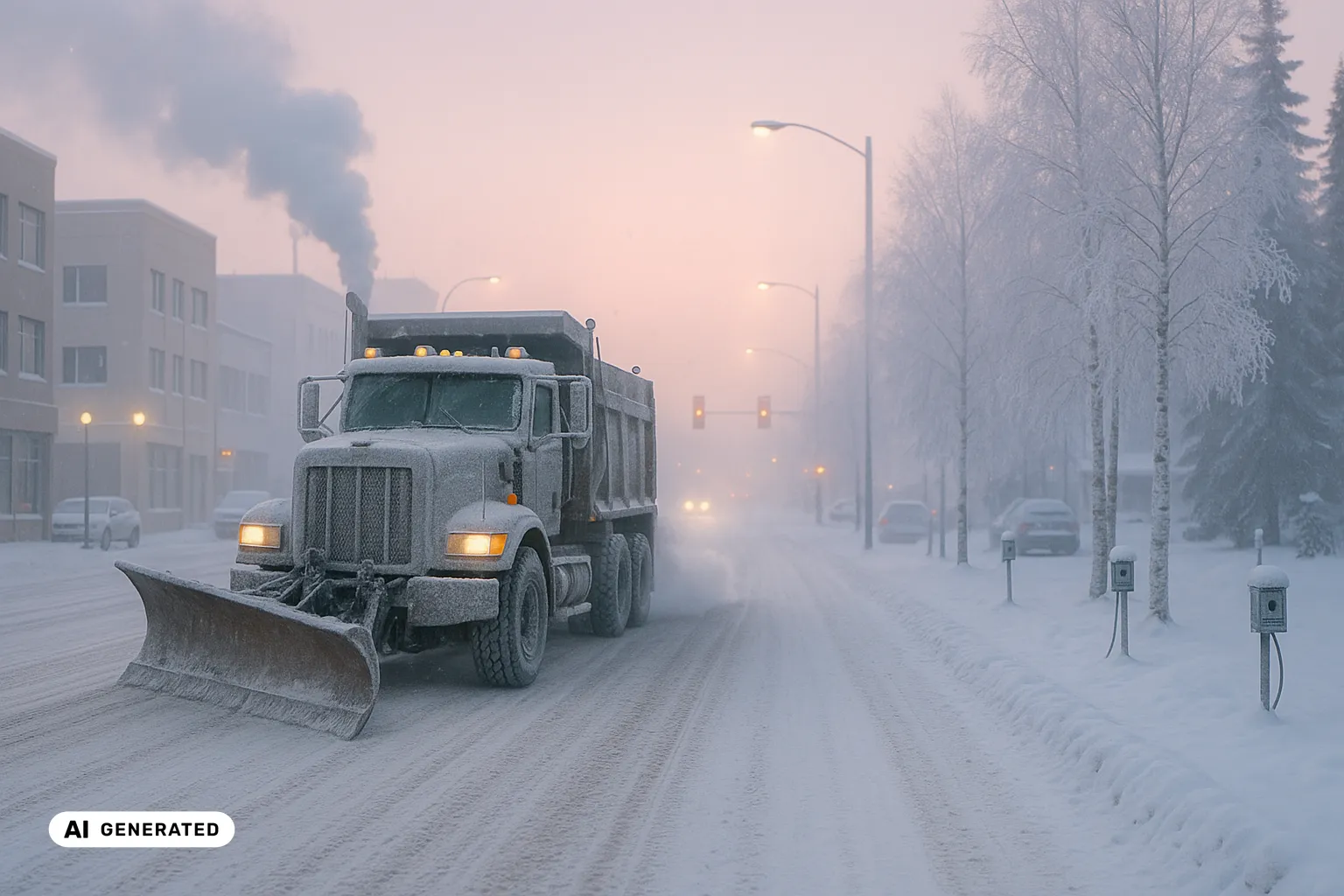
Fairbanks is not a snowy city, and saying so is the fastest way to explain what makes winter work here difficult. The National Weather Service office in the city gives the normal season at 65.0 inches, from a record that reaches back to 1904. Buffalo gets more. Marquette gets far more. Syracuse, the snowiest big city in the country, gets nearly double.
What Fairbanks has instead is temperature. Over the 1991–2020 normals the mean January high is 0.6 °F and the mean January low is −17.2 °F. About 114 days a year have a low of zero or below. The record is −66 °F, from January 1934. That single difference — cold that arrives in October and does not let go until April — changes the tools, the chemistry, the schedule and the question of who is responsible for what.
Why salt is not in the toolbox
The City of Fairbanks does not salt its streets. It sands them, with fine rock chips, and it repeats the sanding through the winter after storms and after significant temperature swings. Come spring, those chips have to be swept back up again, which is its own annual operation.
This is not a preference. The state publishes the reason on its own site. Alaska DOT&PF describes its salt brine — a solution of water and 23.3 per cent sodium chloride — as most effective when applied before snow and ice accumulate and “at temperatures of 20 F and above”, with anti-icing requiring “pavement temperatures of +15 F or higher”.
Set that against a mean January low of −17.2 °F and the gap is about 32 Fahrenheit degrees. For most of the winter, the working range of the chemistry is simply somewhere else.
So the state does something that reads oddly until you understand it: below that range, it sprays the brine onto sand as the sand goes down, so that the sand sticks to the ice and does not blow off the road. The chloride is being used as glue, not as a de-icer. Clear Roads, the pooled research programme run by state transportation departments, states the underlying point plainly — as temperatures drop, sodium chloride loses its de-icing power, and adding more of it can be both ineffective and wasteful.
The practical consequence is that the goal here is traction, not bare pavement, and that what accumulates is not slush but hardpack — a driven-in layer of snow and ice that no chemistry is going to lift. The City says removing it can take several hours and may require graders to build multiple berms to do the work safely. In a city with thaws, that layer disappears on its own a few times a winter. In Fairbanks it does not.
Ice fog, and why it matters to a crew
Ice fog is the local phenomenon with a temperature on it. It does not form until the air reaches roughly −30 °F, and it clears once the temperature climbs back above that. It is made of the water the city itself puts into the air — exhaust, chimneys, power plants — freezing straight into suspended crystals because the air is too cold to hold it as vapour.
For a plow or sander crew this is a visibility problem that arrives precisely when the roads most need attention, and the largest source in any given street is the traffic in it. It is also the reason the deep-cold days feel still: ice fog forms under the same inversion that traps the cold air in the valley floor.
It has become much less common as extreme cold has. Work by the Alaska Climate Research Center, published in the Journal of Applied Meteorology and Climatology in 2023, found the median number of ice fog days at the airport fell from 16.5 a season in 1950/51–1979/80 to 6 in 1990/91–2019/20 — a decline of some 60 to 70 per cent, tracking the drop in days below −30 °F.
That trend does not make the winters mild. In the 2025/26 season Fairbanks recorded, as of mid-March 2026, 29 days with lows at or below −40 — the sixth most on record, according to reporting on National Weather Service figures. Rarer is not the same as gone.
What the local rules say
The City states that under Fairbanks General Code Sec. 70-161, property owners are responsible for clearing and maintaining the sidewalks adjacent to their property, including snow, ice and other hazards.
Three details are worth having exactly right, and the section itself supplies them.
First, the duty falls on “a person having control of any premises” bordered by a graded or paved sidewalk — not specifically on the owner. A tenant or a managing agent can be the person the ordinance means.
Second, the deadline is “promptly”. There is no figure in hours. Fairbanks has nothing equivalent to Grand Rapids’ 24 hours or Fargo’s competing 9 p.m. and 24-hour statements — the standard is a word, not a clock, and anyone quoting a specific number of hours for Fairbanks is quoting something else.
Third, the requirement for ice is to “remove or sand any ice which forms on the sidewalk”. Sanding is written into the ordinance as an equal way to comply, not as something you do afterwards. The cold is in the legal text as much as it is in the operational practice.
All of it is then qualified by one clause at the end: the duty bites “to the extent that the snow or ice is an impediment to pedestrians”. Not a standard of bare pavement, and not a standard of appearance.
Worth knowing for anyone reading older references: the section used to be numbered 70-321. An ordinance of 18 June 2022 renumbered the former §§ 70-321 and 70-322 as 70-161 and 70-162, which is why both numbers turn up in search results for the same rule.
The City is not leaving all of it to property owners. It maintains sidewalks in designated areas — along major routes, school walking corridors and specific public facilities — out of a network the Street Division puts at 27 miles of sidewalk alongside 355 lane miles of street.
And twenty kilometres down the road, the neighbouring City of North Pole does the opposite. Its Public Works department states that as a public service in winter it plows all the pedestrian paths throughout the city, regardless of whether they are city or state owned. Two municipalities in one borough, two opposite answers to the same question.
What it costs, and what it costs for
The same section carries two quite different consequences, and they are worth keeping apart, because the City’s public materials tend to blur them.
Not clearing your sidewalk does not draw a fine. It draws a bill, on a clock. Under § 70-161(d) the director of public works may direct the removal of snow or ice that has not been promptly cleared, and the cost is charged to the property owner — provided the owner or person in control has failed to act within five working days after having received contact from the director. So the sequence is contact first, five working days, then the City does it and invoices.
Moving snow onto the public way is the one that carries a fine. Section 70-161(b) makes it unlawful to move snow or ice from private property — or to hire, direct or allow someone else to move it — onto any sidewalk, street, avenue or alley “to the extent that the snow or ice is an impediment to use of the sidewalk, street, avenue, or fire hydrant”. Under § 70-161(c) that is a minor offence, disposable without a court appearance on payment of a $200 fine plus the state surcharge, with 30 days to respond to the city clerk. The code adds that these fines “may not be judicially reduced”. Subsection (e) then allows the same cost-recovery mechanism, on the same five-working-day terms, for snow that was moved onto the street.
And there is one express permission that saves a lot of argument:
It is not a violation of this subsection to move snow from a sidewalk into the adjacent street.
Sidewalk snow may go into the road, where it is picked up during removal operations. The driveway pile may not.
The same prohibition applies outside the city limits. The borough points to Title 12 of its code, Protection of Public Roads and Areas, which prohibits encroachments on the road and the road right of way, and gives the reason directly: snow pushed into the road endangers and obstructs the contractors who have to clear it.
Weeks, not hours
The single most important operational number in Fairbanks is the residential rotation, and it is measured on a calendar rather than a clock.
The City clears main roads, emergency routes, school zones and key public areas first, so that police, fire, ambulance and school buses keep running. It then works through residential neighbourhoods on what it calls an approximate four-to-six-week turnaround, and states that in a typical winter the snow will be removed and hauled away twice in a neighbourhood over the season. If a significant snowfall lands mid-rotation, crews return to the arterials and then pick the rotation back up where they stopped.
Part of the reason is that clearing here is two operations rather than one: immediate plowing during a storm, and then widening the roads later by removing the snow berms. Between those two passes the berm sits at the edge of the carriageway — and with a four-to-six-week rotation, it can sit there a long time. Driveway aprons, sight lines at junctions and pedestrian crossings all live with it in the meantime.
Downtown runs on a different clock. Crews typically work 9:00 p.m. to 7:30 a.m., covering the downtown core and the main arterials — Cushman, Noble, Wickersham, Cowles, Lacey and the Old Steese Highway.
Parking is managed block by block rather than by a citywide emergency. Signs reading “NO PARKING AFTER 7 AM” go up after noon the day before, at a minimum of four signs per block, with an additional sign placed beside any vehicle that looks likely to be towed. For Island Homes, Walden Estates and Arctic Park the City puts out reader boards 24 hours ahead and signs at least 12 hours ahead. Downtown also has a standing window: no parking on Mondays from 1:00 a.m. to 6:00 a.m. in designated zones.
The towing criterion is worth noting for what it says about evidence: staff look for vehicles carrying multiple layers of accumulated snowfall, indicating they have not moved in a while, and then photograph the posted block and photograph each marked vehicle. Location, subject, timestamp.
Who plows your road
Three bodies, cleanly separated, and confusing them is the most common local mistake.
The City of Fairbanks maintains the 355 lane miles inside the city limits — along with 97 miles of storm drain piping, 2,565 catch basins and 93 outfalls to the Chena River and the Noyes Slough, which is a useful reminder of how much water runs through the built-up area.
Alaska DOT&PF, Northern Region, headquartered in Fairbanks, holds the highways: the Steese, the Richardson, the Parks. Its territory covers around 370,000 square miles — roughly 65 per cent of the land area of Alaska — across seven maintenance districts and 37 active stations, with more than 8,800 lane miles of road. Its winter priority system runs from Priority 1 down to a category most states do not have on the books at all: Priority 5, “No Winter Maintenance”, which currently includes the Denali Highway and the Taylor Highway. Some state roads here are officially not cleared.
The Fairbanks North Star Borough is the one that surprises people, because it is largely not a road authority. It is a second class borough and states that it “does not have area-wide powers by Alaska Statute (AS) 29.35.490”, and that without area-wide road powers it may only collect taxes for road maintenance where the residents of an area have voted for it.
What exists instead is 103 road service areas, covering roughly 485 miles of road, established by voters and overseen by volunteer commissioners who handle all aspects of maintenance and repairs. The borough’s Rural Services Division supplies supervision, administration, procurement, engineering and mapping — not plows.
For anyone running a winter service business, that structure is the local market: two thirds of the region’s 95,655 residents live outside the 32,515 inside the city line, and out there the customer is often a volunteer commission acting for a few dozen neighbours.
The hills are the warm side
One last piece of local knowledge, because it inverts an assumption almost everyone brings from somewhere else.
Fairbanks sits at 446 feet on the floor of the Tanana Valley, where the Chena River meets the Tanana. Cold air pools there. The result is an inversion described as one of the biggest on Earth — and it runs the opposite way to the ones that shape most winter cities.
A winter of paired measurements reported by the UAF Geophysical Institute compared a home at about 1,600 feet with the Goldstream Valley at about 590 feet. The house on the hill averaged around 16 °F warmer. On some days the difference exceeded 25 °F. On more than a quarter of the days, the daily minimum on the hill was higher than the daily maximum in the valley.
So in Fairbanks, going uphill — Chena Ridge, Farmers Loop, Ester Dome — does not mean colder and snowier, the way it does in Salt Lake City or Worcester. It means warmer. A route that climbs out of the valley can cross from hard, dry, squeaking snow into something much closer to ordinary winter conditions, and the treatment that suits one end of it does not necessarily suit the other.
The cold is regulated, too, in a way that says a great deal about the place. Borough Code 21.24.010 runs a vehicle plug-in programme: between 1 November and 31 March, employers above a set size with outlets in their car parks must supply electricity to those outlets on days when the temperature falls below 21 °F, as measured by the National Weather Service at Fairbanks International Airport. Power may be cycled every other hour to save energy — and a log has to be kept for five years and produced on request. A municipality that legislates when the car park sockets must be live, and requires half a decade of records to prove it, is a municipality that has thought carefully about cold.
Keeping the record straight
In a city where the standard is “promptly” rather than a number of hours, where sanding is a lawful alternative to removing ice rather than an extra, and where the plow may next come down a residential street in four to six weeks, the useful thing is being able to show plainly what was done and when.
Not to win an argument. Because a winter that runs from October to April without a thaw produces exactly the questions a vague answer cannot settle: was this frontage treated, was it sanded or cleared, what was the temperature when the crew was there, and how long had it been since the last pass. A simple, time-stamped record of each treatment, set against what the weather was actually doing, turns “we were out all week” into something specific — a clear service record whether you look after one downtown frontage or a contract for a road service area out past Ester.
That is the documentation support Wintertrace is built to make easy. It does not change any local rule, and it is not a substitute for legal advice. It just means that when someone asks what happened during the cold snap, the answer is on file.
Local facts
- Fairbanks averages about 65 inches of snow a year. The National Weather Service office in Fairbanks states the figure as "Normal Snow: 65.0" in its annual snowfall rankings for the city, drawn from a record that runs from 1904 to the present. That is less than Buffalo, less than Marquette, and less than most of the snowbelt cities people think of as hard winter towns.Source (PDF)
- The temperature is the whole story. Over the 1991–2020 normals at Fairbanks International Airport, the mean January high is 0.6 °F (−17.4 °C) and the mean January low is −17.2 °F (−27.3 °C). The record low is −66 °F (−54 °C), set on 14 January 1934.Source
- On the same 1991–2020 basis, Fairbanks records about 114 days a year with a low of 0 °F or below. For comparison, that is not a cold snap — it is roughly a third of the calendar.Source
- The snow stays. On an average of 37 days a year the snow on the ground is 20 inches deep or more, and the city is normally free of snow only from June to August. Because there are no thaws to reset it, the season is one continuous surface rather than a series of storms.Source
- The first measurable snowfall of the season arrives on 1 October in the mean, based on the 1915–2015 record. The earliest on record is 29 August; the latest is 31 October. Planning a winter operation here starts in summer.Source (PDF)
- The City of Fairbanks does not put salt on its streets. It sands them with fine rock chips, and states that the sanding is often repeated through the winter, particularly after snowstorms or significant temperature swings. The chips then have to be swept back up after the melt.Source
- The state explains why. Alaska DOT&PF describes its salt brine as most effective when applied before snow and ice accumulate and "at temperatures of 20 F and above", with anti-icing needing "pavement temperatures of +15 F or higher". Fairbanks sits roughly 32 Fahrenheit degrees below that in the January mean low.Source
- When it is colder than that, the state sprays the brine onto sand instead — so that the sand sticks to the ice and does not blow off the road. The chemistry is not being used to melt anything. It is being used as glue.Source
- Ice fog is a Fairbanks phenomenon with a temperature threshold: it does not form until the air reaches roughly −30 °F, and it clears when the temperature rises above that. It is made of the water vapour the city itself emits — exhaust, chimneys, power plants — freezing in air too cold to hold it.Source
- It has become markedly rarer as the deep cold has. Research from the Alaska Climate Research Center, published in the Journal of Applied Meteorology and Climatology in 2023, found the median number of ice fog days at Fairbanks airport fell from 16.5 a season in 1950/51–1979/80 to 6 in 1990/91–2019/20.Source
- Under Fairbanks General Code Sec. 70-161, the City states that property owners are responsible for clearing and maintaining the sidewalks adjacent to their property, including snow, ice and other hazards. The City itself maintains sidewalks only in designated areas — along major routes, school walking corridors and specific public facilities.Source
- The ordinance text obliges "a person having control of any premises bordered by a graded or paved sidewalk" — not only an owner — to "promptly remove any snow which falls on the sidewalk and must remove or sand any ice which forms on the sidewalk, to the extent that the snow or ice is an impediment to pedestrians". There is no deadline in hours, sanding is written in as an equal alternative to removal, and the whole duty is qualified by whether pedestrians are actually impeded.Source
- Failing to clear does have a consequence, and it runs on a five-day clock rather than a fine. Under § 70-161(d) the director of public works may direct the removal of snow or ice not promptly cleared from a sidewalk, and the cost is charged to the property owner if the owner or person in control fails to act "within five working days after having received contact from the director of public works".Source
- Moving snow off a sidewalk into the road is expressly permitted. Section 70-161(b) bans moving snow or ice from private property onto a sidewalk, street, avenue or alley where it impedes use or blocks a hydrant — then states plainly: "It is not a violation of this subsection to move snow from a sidewalk into the adjacent street."Source
- The $200 figure is a code fine rather than a service charge. Section 70-161(c) makes a violation of the deposit ban a minor offence disposable without a court appearance on payment of a $200 fine plus the state surcharge, with 30 days to respond to the city clerk — and the fines "may not be judicially reduced".Source
- The one priced consequence the City publishes is not about failing to clear a sidewalk. Moving snow from private property or driveways into the street, the City right of way or a drainage ditch can bring "a minimum $200 fee or the cost of removal for City staff and equipment".Source
- Residential streets are cleared on an approximate four-to-six-week rotation, and in a typical winter the snow is removed and hauled away twice in a neighbourhood over the whole season. Clearing here is two jobs: plowing during the storm, then widening the road later by taking the berms away.Source
- Alaska DOT&PF operates a five-level winter priority system in which Priority 5 means, in the state's own words, "No Winter Maintenance" — the Denali Highway and the Taylor Highway among them. Some state roads are officially not cleared at all.Source
- Outside the city line, neither the city nor the borough is likely to be plowing. The Fairbanks North Star Borough is a second class borough and states that it "does not have area-wide powers by Alaska Statute (AS) 29.35.490" — it may only collect road maintenance taxes where residents have voted for it.Source
- In place of a borough road department there are 103 road service areas covering roughly 485 miles of road, run by volunteer commissioners who oversee all aspects of maintenance and repairs, with the borough supplying only supervision, procurement and technical support.Source
- The temperature inversion here runs the opposite way to most cities: the hills are the warm side. A winter of measurements compared by the UAF Geophysical Institute found a home at about 1,600 feet averaged some 16 °F warmer than the Goldstream Valley at about 590 feet, and was more than 25 °F warmer on some days.Source
- Studded tyres are legal here for most of the year. North of 60° north latitude — Fairbanks is at 64°50′ — Alaska DOT&PF states it is unlawful to run them on a paved road from 1 May through 15 September, which leaves them permitted from mid-September to the end of April.Source
- Twenty kilometres away, the neighbouring City of North Pole takes the opposite approach to sidewalks: its Public Works department states that as a public service in winter it plows all the pedestrian paths throughout the city, whether they are city or state owned.Source
Official contacts
City of Fairbanks — Snow Removal Operations
The operational page: FGC Sec. 70-161 and who clears which sidewalk, clearing priorities, the night shift, the "NO PARKING AFTER 7 AM" signing routine, and the minimum $200 fee for pushing snow into the right of way.
City of Fairbanks — Neighborhood Snow Rotational Schedule
Where the residential rotation currently stands, and the City's own statement of the four-to-six-week turnaround.
Fairbanks North Star Borough — Rural Services and road service areas
The 103 road service areas, what the volunteer commissioners decide, and what the borough does and does not do. The place to start if the property is outside the city line.
Alaska DOT&PF — winter road maintenance priorities, Northern Region
The five-level state priority system, including Priority 5 — no winter maintenance — with the interactive priority map linked from the same area of the site.
NWS Fairbanks — northern Alaska climate data
The local Weather Service office's climate pages, including the snowfall rankings and first-measurable-snowfall records cited above.
Common questions about winter service in Fairbanks
- Do I have to clear the sidewalk in front of my property in Fairbanks, and by when?
- Yes, in most locations — but there is no clock. Fairbanks General Code § 70-161(a) puts the duty on "a person having control of any premises bordered by a graded or paved sidewalk", who must "promptly remove any snow which falls on the sidewalk and must remove or sand any ice which forms on the sidewalk, to the extent that the snow or ice is an impediment to pedestrians". So a tenant or a manager can be the person responsible; there is no fixed number of hours to point at; sanding counts as compliance for ice rather than being an extra; and the whole duty is measured against whether pedestrians are actually impeded. If it is not done, § 70-161(d) lets the director of public works have it cleared and bill the owner — but only after making contact and allowing five working days. The City also clears some sidewalks itself, along major routes, school walking corridors and specific public facilities. This is general information rather than legal advice.
- Why doesn't the city use salt?
- Because it would not work. The City sands with fine rock chips instead, and the state explains the physics on its own site: Alaska DOT&PF describes its salt brine as effective "at temperatures of 20 F and above", with anti-icing needing pavement at +15 °F or higher. The mean January low here is −17.2 °F. Below that working range the state sprays brine onto sand so the sand sticks to the ice rather than blowing off the road — the chemistry is doing an adhesion job, not a melting one. The practical consequence for anyone maintaining a property is that traction is the goal, and that a hard-packed surface has to be taken off mechanically. The City notes that hardpack removal can take several hours and may need graders to build multiple berms to do it safely.
- How long will it take for my residential street to be plowed?
- Plan in weeks. The City clears main roads, emergency routes, school zones and key public areas first, then works through residential neighbourhoods on what it describes as an approximate four-to-six-week turnaround, with the snow removed and hauled away twice in a typical winter. Clearing is deliberately two separate operations: plowing during the storm, then coming back later to widen the road by removing the berms. If a significant snowfall arrives mid-rotation, crews go back to the arterials and then resume where they left off. For anyone looking after a property here, that means the berm at the end of the driveway is not a delay in the schedule — it is the schedule.
- Who actually plows my road if I live outside the city?
- Very possibly a contractor hired by your neighbours. The Fairbanks North Star Borough is a second class borough and states that it does not have area-wide road powers under AS 29.35.490, so it cannot simply maintain roads across its territory. Instead there are 103 road service areas, together covering around 485 miles, established by voters and overseen by volunteer commissioners; the borough supplies supervision, procurement and technical services. The highways — Steese, Richardson, Parks — belong to Alaska DOT&PF's Northern Region. So three different bodies plus a volunteer commission may be involved within a few miles, and which one applies is a question of the address, not the neighbourhood.
- What is ice fog, and does it affect winter work?
- It is a ground-level cloud made of the water vapour the city emits — vehicle exhaust, chimneys, power plants — freezing directly into ice crystals because the air is too cold to hold it as vapour. It does not form until roughly −30 °F and clears when the temperature rises past that. For a plow or sander crew it is a visibility problem at exactly the times the roads most need work, and the largest single source in a street is the traffic itself. It is also becoming rarer as extreme cold does: research published in the Journal of Applied Meteorology and Climatology in 2023 found the median at the airport fell from 16.5 days a season in 1950/51–1979/80 to 6 in 1990/91–2019/20.
- Can I push the snow from my driveway into the street?
- No — and this is where the code does put a number on it. Section 70-161(b) makes it unlawful to move snow or ice from private property, or to hire or direct someone else to move it, onto any sidewalk, street, avenue or alley to the extent it impedes use of that way or blocks a fire hydrant. Under § 70-161(c) that is a minor offence, settled without a court appearance on payment of a $200 fine plus the state surcharge, with 30 days to respond to the city clerk, and the code states these fines may not be judicially reduced. Subsection (e) additionally lets the City clear it and recover the cost if the owner has not dealt with it within five working days of being contacted. One thing is expressly allowed, though: the section states that it is not a violation to move snow from a sidewalk into the adjacent street. The sidewalk pile may go curbside; the driveway pile may not. Outside the city the borough has its own prohibition, in Title 12 of its code, Protection of Public Roads and Areas — the stated reason being the risk to the contractors who have to clear it.
- When can I run studded tyres?
- North of 60° north latitude, which includes Fairbanks at 64°50′, Alaska DOT&PF states it is unlawful to operate a vehicle with studded tyres on a paved highway or road from 1 May through 15 September inclusive. In practice that leaves them legal from mid-September to the end of April. South of 60° N the closed season is different — 15 April to 30 September — so a rule quoted for Anchorage does not transfer here. Anchorage also has its own municipal timing on top of the state rule, which Fairbanks does not.
Documenting winter service in Fairbanks
Anyone clearing snow and ice in Fairbanks may later need to show when and where a route was treated. Wintertrace is open-source software that records exactly that — time, location and weather for each run — as a calm basis for your own operational records and service proof. It is not a substitute for legal advice.
This overview is for general information and is not legal advice. Local rules on snow and ice clearing vary — the wording of the local rule and the responsible authority always govern.