Winter service · Northwest Territories
Winter service in Yellowknife
What winter is really like in Yellowknife: about 155 cm of dry snow a year and a January that averages −25 °C on the shore of Great Slave Lake. Why extreme cold means sand, not salt; the City's three-tier plough priority and driveway windrows; and the sidewalk-clearing duty that only applies downtown — not to most homes.
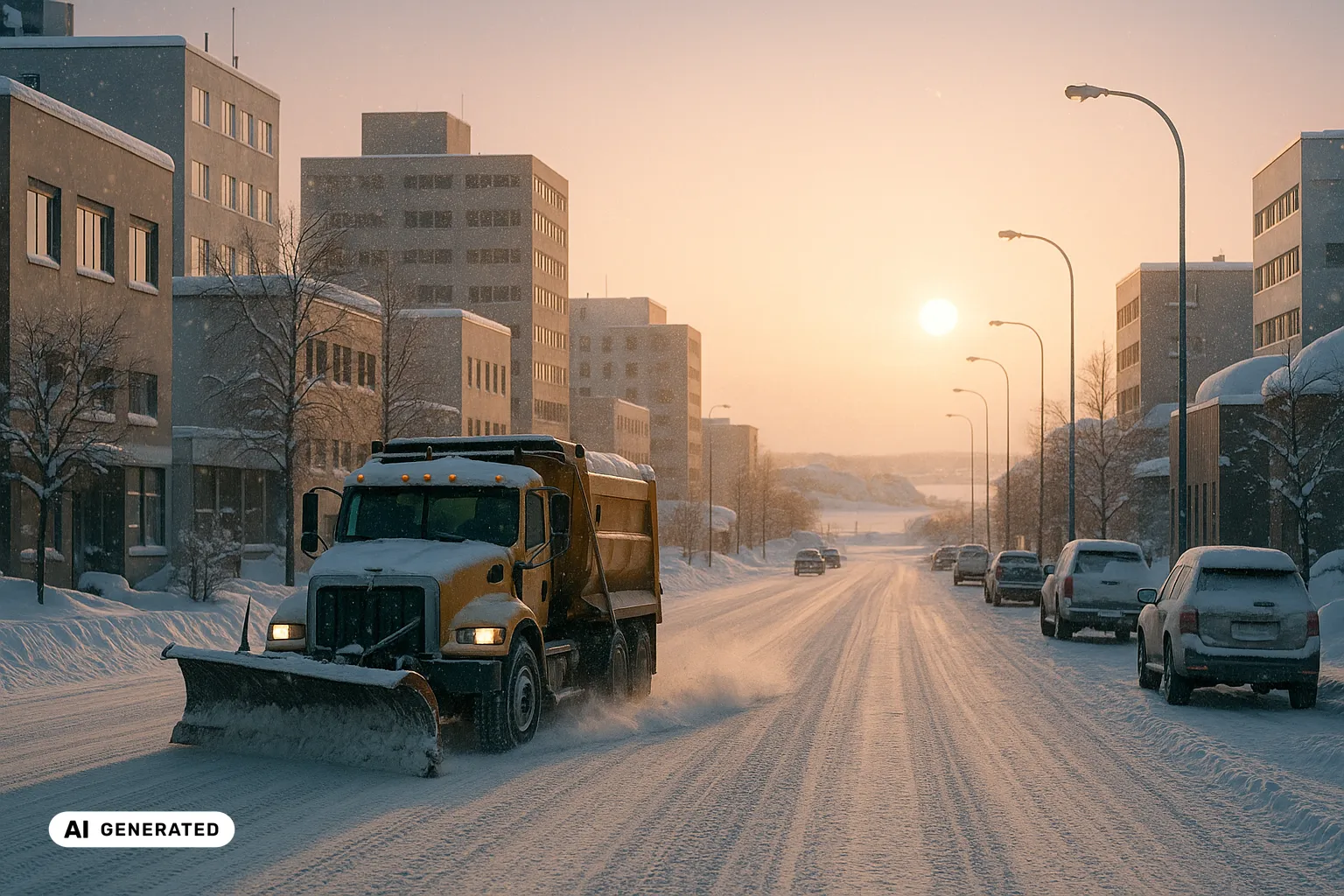
What winter actually does in Yellowknife
Yellowknife sits on the north shore of Great Slave Lake, on the bare rock of the Canadian Shield, about 400 kilometres south of the Arctic Circle. The last ice age scoured the land down to rock, and what it left is the city’s setting: low, rolling exposed bedrock and countless small lakes, at about 206 metres of elevation. This is the capital of the Northwest Territories, and it is one of the coldest cities in Canada.
Two numbers frame the winter. The first is snowfall — about 155 cm (61 in) a year on Environment and Climate Change Canada’s 1991–2020 normals. That is less total depth than the snowiest cities further south, and it is almost the least important thing to know about winter here. The second number is the one that matters: a January that averages about −25.5 °C, with an average daily low near −29.4 °C and an all-time record of −51.2 °C set in 1947. Yellowknife’s winter is defined by cold and length, not by any single big storm.
The city is also dry — it lies in the rain shadow of mountains to the west, with under 300 mm of precipitation a year. So the snow that falls is cold and dry: light, powdery, and prone to drifting in the wind rather than the wet, heavy snow that loads roofs on the coasts. It arrives around October and stays through to April or May, a very long snow season lived through only a few hours of daylight around the December solstice. The practical picture is not one dramatic dump to dig out from, but months of dry, packed, wind-blown snow in deep cold.
Why the City sands instead of salts
The single most telling fact about winter maintenance here follows directly from that cold: the City relies mainly on sand, not salt. Road salt is a de-icer — it lowers the freezing point of water — and it stops working as temperatures drop well below freezing. In a place where January sits around −25 °C, salting achieves little, so the goal shifts from melting snow and ice to giving tyres traction on packed snow with sand and grit.
That one choice cascades through the whole operation. Roads stay snow-packed rather than wet and bare; the spring brings a city-wide clean-up of all the sand that was spread; and the everyday hazard is less the freezing rain of a milder city than drifting and hard-packed snow on a long, cold road network. If you know one thing about how Yellowknife differs from, say, a freeze-thaw city like Winnipeg or the prairie cold of Edmonton, it is this: the work is traction, sustained over months, not melting.
What the local rules say — and the part people get wrong
Here is the distinction worth reading carefully, because the common assumption — the owner clears the sidewalk in front of the house — is not true across most of Yellowknife.
The owner-clears-the-sidewalk duty applies only downtown. Under the City’s Highway Traffic By-law, the occupier of property abutting a sidewalk in the Central Business District, along defined stretches of 50th Avenue, and — added by By-law No. 4446 — a section of Franklin Avenue (Matonabee Street to 57 Street) must clear snow and ice within 24 hours. In those downtown zones, the duty is real and on the books.
Outside those zones, there is no bylaw sidewalk-clearing duty on a residential owner. The City instead asks residents to clear the snow that ploughing leaves on their own walks and driveways, and it prohibits shovelling snow back onto the roadway. So the honest answer to “do I have to shovel my sidewalk?” is: it depends on where you are — an obligation downtown, a request everywhere else. The same bylaw also sets a spring deadline: every occupier of property abutting a sidewalk has to remove the winter’s sand, grit and debris by 15 May each year — the other side of a winter spent sanding for traction.
Because the City’s own bylaw text has been consolidated and renumbered over time, the reliable move is to read the current Highway Traffic By-law and winter guidance directly rather than rely on a single section number. None of this is legal advice; the point is simply what the City says and where it applies.
How the City clears — priorities, timing and windrows
On the road side, the Public Works and Engineering Department runs the ploughing and works to a three-tier priority. Primary routes come first — freeways, major arterials, emergency routes and main bus routes. Secondary covers the remaining arterials, the Central Business District, streets near schools and routes to key facilities. Tertiary is everything else: all other City roads, parking lots and alleyways. Residential streets sit in that last tier, so after a snowfall the arterials and bus routes are cleared before the quiet streets.
Hauling the snow away is a separate, scheduled operation. It typically runs from December into late April, often starting in the early hours from midnight, with 24 hours’ notice posted on signs before crews reach a street. And it leaves its own signature at every driveway: a windrow, the ridge a grader pushes to the side, typically 100–300 mm (4–12 in) high across driveway entrances. The City does not cut an apron through it — clearing that bank to reach the road is the resident’s job. It is a small thing that shapes daily life all winter: a street can be cleared and still leave you a firm ridge to dig out.
The lake, the ice roads and the neighbours
Yellowknife’s winter geography includes something few cities have: roads on the lake. The Yellowknife–Dettah ice road runs about 6.5 km across the frozen surface of Yellowknife Bay, normally open from around 18 December to around 19 April; the year-round alternative is a 27 km drive via the Ingraham Trail. These ice roads are regular winter transport infrastructure, but they are built and managed under the Government of the Northwest Territories, not the City’s road crews — so they sit alongside, rather than inside, the municipal plough-and-sand operation.
The immediate neighbours are small and distinct. Ndilǫ sits at the north end of Latham Island, right against the city; Dettah is the community reached by that ice road across the bay; and Behchokǫ̀, the largest Tłı̨chǫ community, lies about 100 km north-west along Highway 3. Each is its own place with its own arrangements — a reminder that even in the sparsely settled North, the local rulebook is the one that counts, and it changes when you leave the city.
Keeping the record straight
In a winter this long and this cold — months of sanding, packed snow and drifting, much of it worked in the dark — the useful thing is being able to show, plainly, what was done and when. Not to win an argument, but because a season that runs from October to spring generates exactly the questions a vague answer can’t settle: was the route sanded, when, in what conditions. A simple, time-stamped record of each treatment, set against what the weather was actually doing, turns “we were out all winter” into something specific. That is the documentation support Wintertrace is built to make easy — a clear log of where a crew went and when — whether you look after a single downtown property with a real sidewalk duty or a fleet of routes across the city. It does not change any local rule; it just means that when someone asks what happened during the last cold snap, the answer is on file. Not a substitute for legal advice.
Local facts
- Yellowknife sits on the north shore of Great Slave Lake, on the bare rock of the Canadian Shield, about 400 kilometres south of the Arctic Circle at latitude 62.5° N — the capital of the Northwest Territories since 1967.Source
- The land was scoured down to rock during the last ice age, leaving a low, rolling landscape of exposed bedrock and countless small lakes at about 206 m (676 ft) of elevation.Source
- It is a dry place — in the rain shadow of mountains to the west, with under 300 mm of precipitation a year (about 294 mm) — so the snow is cold and dry rather than the wet, heavy load of milder cities.Source
- About 155 cm (61 in) of snow falls in an average year, according to Environment and Climate Change Canada's 1991–2020 normals for the Yellowknife A station.Source
- January is deep winter: a daily mean of about −25.5 °C and an average daily low near −29.4 °C (ECCC 1991–2020); the all-time record low is −51.2 °C, set on 31 January 1947.Source
- The climate is subarctic (Köppen Dfc): a very long snow season running roughly October to April or May, and — at 62.5° N — only a few hours of daylight around the December solstice.Source
- Because road salt barely works at these temperatures, the City relies mainly on sand for traction rather than de-icing salt — a different winter-maintenance approach from milder Canadian cities.Source
- The City clears roads in three priority tiers: primary (freeways, major arterials, emergency and main bus routes), secondary (remaining arterials, the Central Business District, streets near schools), and tertiary (all other roads, City lots and alleyways).Source
- Snow removal — hauling the ploughed snow away — typically runs from December to late April, often starting in the early hours from midnight, with 24 hours' notice posted on signs before crews clear a street.Source
- After a grader passes, it leaves a windrow across driveway entrances — a drop-off typically 100–300 mm (4–12 in) high — and the City does not cut a driveway apron, so clearing that ridge is left to the resident.Source
- The owner-clears-the-sidewalk duty applies only downtown: the City's Highway Traffic By-law requires the occupier of property abutting a sidewalk in the Central Business District and along defined stretches of 50th Avenue to clear snow and ice within 24 hours; By-law No. 4446 added a section of Franklin Avenue (Matonabee Street to 57 Street) for snow clearing.Source
- Outside those downtown zones there is no bylaw sidewalk-clearing duty on residential owners — the City instead asks residents to clear the snow that ploughing leaves on their own walks and driveways, and prohibits shovelling snow back onto the roadway.Source
- Every occupier of property abutting a sidewalk must also remove the winter's sand, grit and debris from that sidewalk by 15 May each year.Source
- The Yellowknife–Dettah ice road across Yellowknife Bay — about 6.5 km over the frozen Great Slave Lake — normally opens around 18 December and closes around 19 April; the year-round alternative is a 27 km drive via the Ingraham Trail.Source
Official contacts
City of Yellowknife — Winter Maintenance & Snow Removal
The City's own winter operation: the three plough-priority tiers, the snow-removal schedule and notice, driveway windrows, and what residents are asked to do.
City of Yellowknife — Public Works and Engineering Department
The department responsible for maintaining roads and sidewalks — ploughing, sanding and snow removal through the winter.
City of Yellowknife — By-law No. 4446 (Highway Traffic By-law amendment)
The amendment adding a section of Franklin Avenue to the downtown sidewalk snow-clearing provisions of the Highway Traffic By-law.
Environment and Climate Change Canada — Yellowknife A climate normals (1991–2020)
The authoritative station record for Yellowknife's snowfall, temperature and precipitation normals.
Common questions about winter service in Yellowknife
- Do I have to shovel the sidewalk in front of my house in Yellowknife?
- For most homes, no — and this is the thing people most often get wrong. The City of Yellowknife's Highway Traffic By-law puts a sidewalk-clearing duty on the occupier of property only in defined downtown zones: sidewalks in the Central Business District, along stretches of 50th Avenue, and — added by By-law No. 4446 — a section of Franklin Avenue. In those zones the snow and ice have to be cleared within 24 hours. Outside downtown there is no bylaw duty on a residential owner to clear the public sidewalk; the City simply asks residents to clear the snow left on their own walks and driveways, and not to shovel it back onto the road. So whether you are obliged or merely asked depends entirely on where in the city you are. This is general information, not a substitute for legal advice — check the current bylaw with the City.
- Why does the City sand the roads instead of salting them?
- Because salt stops working in real cold. Road salt loses its de-icing effect as temperatures fall well below freezing, and a Yellowknife January averages around −25 °C, with record lows past −50 °C. At those temperatures spreading salt achieves little, so the City relies mainly on sand to give tyres something to grip. It is one of the clearest ways northern winter maintenance differs from a milder city: the goal is traction on packed snow, not melting it away.
- How much snow does Yellowknife actually get?
- About 155 cm (61 inches) in an average year, on Environment and Climate Change Canada's 1991–2020 normals for the airport station. That is less total depth than the snowiest cities further south, but it is the wrong number to focus on. Yellowknife's winter is defined by length and cold, not by any single big dump: the snow arrives around October, stays through to April or May, and — because the air is so dry and cold — it comes as light, dry snow that drifts in the wind rather than the wet, heavy snow of the coasts. It accumulates and stays put for months.
- Will the City plough my street, and how soon?
- Yes, but in order of priority. The City works in three tiers: primary routes first — freeways, major arterials, emergency and main bus routes — then secondary roads including the Central Business District and streets near schools, then tertiary roads, which is everything else, along with City parking lots and alleyways. Residential streets fall into that last tier, so after a big snowfall the main and bus routes are cleared before the quieter streets. Separately, hauling the snow away is a scheduled operation that runs from December into late April, usually starting in the small hours, with signs posted 24 hours ahead.
- What is the ridge of snow left across my driveway, and who clears it?
- That is a windrow — the line of snow a grader pushes to the side as it clears the street, which piles up across driveway entrances. In Yellowknife the City states it typically leaves a drop-off of 100 to 300 mm (4 to 12 inches) at driveways and does not cut an apron through it, so clearing that ridge is the resident's job. It is worth knowing before winter: a street can be 'ploughed' and still leave you a firm bank to dig through to reach the road.
- When do I have to clean the sand off the sidewalk?
- By 15 May. The same bylaw that sets the downtown sidewalk-clearing duty also requires the occupier of property abutting a sidewalk to remove the winter's accumulated sand, grit and debris from that sidewalk by 15 May each year. After a winter of sanding for traction, that spring clean-up is a real obligation, not just tidiness — the grit that kept people upright in January has to be swept up once the snow is gone.
- Are the ice roads part of the City's winter service?
- No — they are a separate piece of winter infrastructure. The best known locally is the Yellowknife–Dettah ice road, about 6.5 km across the frozen surface of Yellowknife Bay, which normally opens around 18 December and closes around 19 April; the alternative is a 27 km drive around via the Ingraham Trail. Ice roads across the territory are built and managed under the Government of the Northwest Territories, not the City of Yellowknife's road crews. They are mentioned here because they are part of how the region moves in winter, but they are not the municipal plough-and-sand operation this page describes.
- How is winter service here different from a southern Canadian city?
- Three things set it apart. The cold is extreme and sustained, so the work is sanding for traction rather than salting to melt — for months, not weeks. The snow is dry and wind-driven, so drifting and packed snow matter more than wet-snow loads. And the season is very long and the daylight very short: crews are working a winter that runs from October to spring, much of it in only a few hours of light around midwinter. A contractor used to a freeze-thaw city further south is really operating in a different regime here — the emphasis moves from clearing wet slush to keeping dry, packed snow safe over a long, cold, dark season.
Documenting winter service in Yellowknife
Anyone clearing snow and ice in Yellowknife may later need to show when and where a route was treated. Wintertrace is open-source software that records exactly that — time, location and weather for each run — as a calm basis for your own operational records and service proof. It is not a substitute for legal advice.
This overview is for general information and is not legal advice. Local rules on snow and ice clearing vary — the wording of the local rule and the responsible authority always govern.